



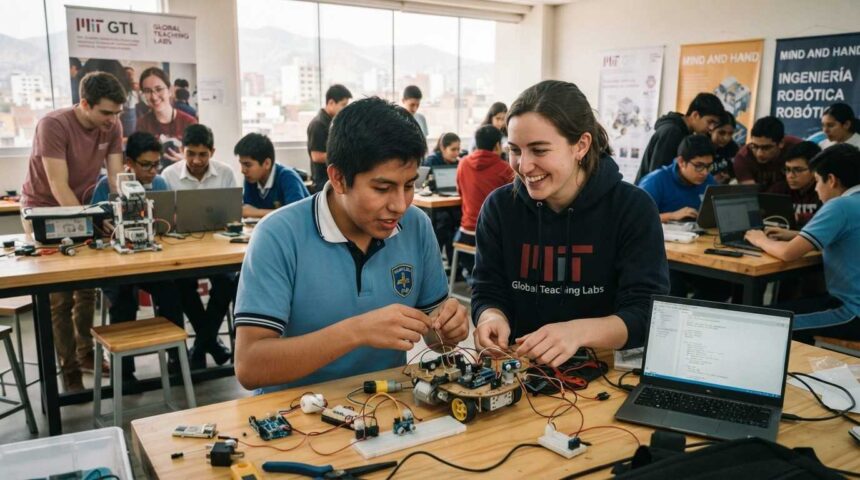
Global Teaching Labs (GTL) is MIT’s program that sends students abroad each January to teach hands-on STEM to high school and university students. If you’re an MIT student deciding how to spend your Independent Activities Period (IAP), or a teacher or school leader weighing whether to host MIT instructors, you’re in the right place.
This guide explains both sides in plain English: how the program runs, who can join, what it costs, and how a school gets involved. Program details and deadlines change every year, so treat this as a starting point and confirm current dates on the official MISTI site before you act.
What Are Global Teaching Labs?
Global Teaching Labs is an MIT program where students travel abroad each January to teach hands-on STEM courses to high school and university students. For three to four weeks each January, GTL participants travel abroad to teach science, technology, engineering, and math (STEM) courses, and sometimes other topics including entrepreneurship and debate, to high school and university students.
GTL is one pillar of MISTI (MIT International Science and Technology Initiatives), MIT’s flagship international education program. It runs on MIT’s mens et manus philosophy, Latin for “mind and hand,” which values learning by doing rather than sitting through lectures.
What students teach is genuinely hands-on. These programmes are not lectures; they are immersive learning experiences where students build, experiment, and solve real-world problems.
Picture a small team of MIT students running a robotics or coding workshop at a host school, guiding teenagers as they build something from scratch. That’s a typical placement, and it’s the heart of what makes GTL different from a standard exchange.
How the GTL Program Works
A single GTL cycle runs from a fall application to a January trip and a short debrief afterward. The timeline below shows the steps and timing at a glance.
| Stage | When | What Happens |
|---|---|---|
| Application | September | Complete the GTL application on the MISTI Portal |
| Interview and selection | September – October | Applications reviewed; selected students contacted for interviews |
| Training sessions | November – December | Pre-departure prep, teaching strategy, and country-specific culture training |
| Teaching abroad | January (IAP) | Around three weeks teaching hands-on STEM at a host school |
| Reentry | After return | Reflect and share what you learned |
The funding model is designed to be cost-neutral. MISTI programs are designed to be cost-neutral, meaning your experience is funded by generous MISTI donors, your host school, or a combination of both, and all essential expenses are covered, including airfare and housing, plus a small stipend for meals and transportation.
Each country runs its GTL a little differently, so format, dates, subjects, and housing vary by placement. Housing varies by country, secured by hosts at school dorms or host families or by the MISTI program, and most students stay with families or at school dorms.
Read Also: Silicon Insider Gordon James Tech: Verified Facts vs Invented Bios
Who Can Take Part, and What It Takes
GTL recruits top MIT students in good academic standing who apply through MISTI and complete an interview. Both undergraduate and graduate students can apply. MIT’s Global Teaching Labs program recruits top MIT students who want to actively participate in the Institute’s experiential approach to learning, and it attracts several hundred highly accomplished candidates from across the Institute.
Some placements have language preferences. Some countries, like Italy and Korea, require no understanding of the local language; others, like France and Spain, really prize this. First-year students often face tighter country and subject options, so flexibility helps.
Selection looks at more than grades. What matters is subject knowledge, adaptability, clear communication, leadership, and real enthusiasm for hands-on teaching.
What if you’ve never taught before? That’s fine, and it’s common. A first-time teacher with strong physics skills and genuine excitement can thrive here, because the fall training sessions cover classroom techniques and communication. Before your GTL, you attend MISTI Prep and Training sessions designed to help you make the most of your experience abroad, covering teaching and communications strategies.
Requirements and deadlines are set fresh each year by MISTI. For IAP 2026, for example, the application deadline was in mid-September 2025, so always confirm the current cycle’s dates on the official site rather than relying on a past one.
Global Teaching Labs in Wales and Beyond
GTL runs in many countries, and Wales is the clearest example of a fully funded host-country partnership. It brings MIT instructors into Welsh classrooms every January at no cost to schools.
The Wales program is a partnership between MIT, MISTI, the Welsh Government, and Equal Education Partners. The first MISTI GTL Wales programme ran in 2019, and since then the initiative has reached over 60,000 students, fully funded by the Welsh Government and delivered at zero cost to schools and colleges.
Host schools get more than a single workshop. The program offers workshops, bespoke projects, tutoring, career guidance, and teacher training to inspire students and enhance STEM education. Sessions like Women in STEM panels and professional learning for teachers round out the offer, and delivery runs across January. The programme runs throughout January, with a first day in schools in early January and the last day in schools in late January.
Wales isn’t the only host. GTL now reaches many regions, including England, Scotland, Germany, Italy, Korea, Mexico, and countries across Africa, Asia, Eurasia, the Middle East, and Latin America. In January 2026, GTL arrived in Cyprus for the first time, with MIT students joining local university students to deliver a hands-on robotics and STEM curriculum to high-schoolers and first-year university students.
Why Global Teaching Labs Matters
For MIT students, GTL builds real teaching and communication skills, offers deep cultural immersion, and provides a funded way to travel during a month that would otherwise be quiet.
For host students and schools, it brings enthusiastic STEM role models into the room and raises aspirations, often at zero cost where the program is funded. The confidence boost can be striking.
Consider a rural school in mid-Wales. One MIT instructor described teaching web development, robotics, and design there while staying with a local host family, gaining as much as the students did. The instructor enjoyed teaching subjects like web development, robotics, and design and manufacturing, gained a deeper understanding of those fields and of teaching, and enjoyed exposing students to the opportunities of higher education no matter their background.
Educators report the ripple effect too. When teenagers realize academics from MIT take their views seriously, many start engaging differently with science and maths, and their belief in what’s possible grows.
Read Also: Uploadwords.com USA Tech
For More Quality Content
GTL sits at the crossroads of education, careers, and opportunity, the kind of practical, decision-support topic we like to unpack. If you found this useful, our newsletter delivers more clear, well-researched guides straight to your inbox, with no spam and an easy unsubscribe.
The Bottom Line
If you’re an MIT student, the smartest move now is simple: watch the MISTI GTL page in late summer, because IAP details and deadlines post around September and spots fill fast. If you lead a school in Wales or another host region, reach out to your country partner early, since sessions are scheduled on a rolling basis. Bookmark the official pages, mark the fall window in your calendar, and act as soon as applications open.
FAQ
What are Global Teaching Labs?
Global Teaching Labs (GTL) is a program run by MISTI at MIT. Each January, selected MIT students travel abroad for three to four weeks to teach hands-on STEM courses, and sometimes debate or entrepreneurship, to high school and university students.
Who runs the Global Teaching Labs program?
GTL is run by MISTI (MIT International Science and Technology Initiatives), MIT’s flagship international education program. In each host country, MISTI works with local partners. In Wales, for example, delivery is a partnership between MIT, the Welsh Government, and Equal Education Partners.
How long does GTL last and when does it happen?
GTL runs for three to four weeks each January, during MIT’s Independent Activities Period (IAP). On average it runs about three weeks between early January and late January, though dates and duration vary by country.
Is Global Teaching Labs paid or free for MIT students?
It’s cost-neutral, so it won’t cost you to take part. All essential expenses are covered, including airfare and housing, and you’ll receive a small stipend for meals and transportation. It isn’t a paid job, but your core costs are handled.
How do I apply for Global Teaching Labs?
You apply through the MISTI Portal, then may be invited to an interview. You complete the MIT GTL application on the MISTI Portal, and MISTI will contact you if you’re selected for an interview. Deadlines change yearly, so confirm current dates on the official MISTI site.
Do I need teaching experience to join GTL?
No. Formal teaching experience isn’t required. What matters more is strong subject knowledge, clear communication, and genuine enthusiasm. MISTI runs pre-departure training that covers teaching and classroom techniques, so first-timers get real support before they travel.
Which countries host Global Teaching Labs?
The list changes each year. Recent cycles have included Wales, England, Scotland, Germany, Italy, Spain, Korea, Mexico, Armenia, Cyprus, and countries across Africa, Asia, the Middle East, and Latin America. Over 400 MIT students were placed across these regions in 2025.
How can a school host MIT Global Teaching Labs instructors?
Schools work through their country’s GTL partner. In Wales, that’s Equal Education Partners, and the program is free to participating schools. Schools get in touch with Equal Education Partners to gain specialist, tailored STEM support, fully funded by the Welsh Government. Elsewhere, contact the relevant MISTI country program to explore hosting.
For more quality, informative content, visit Write Whiz.