



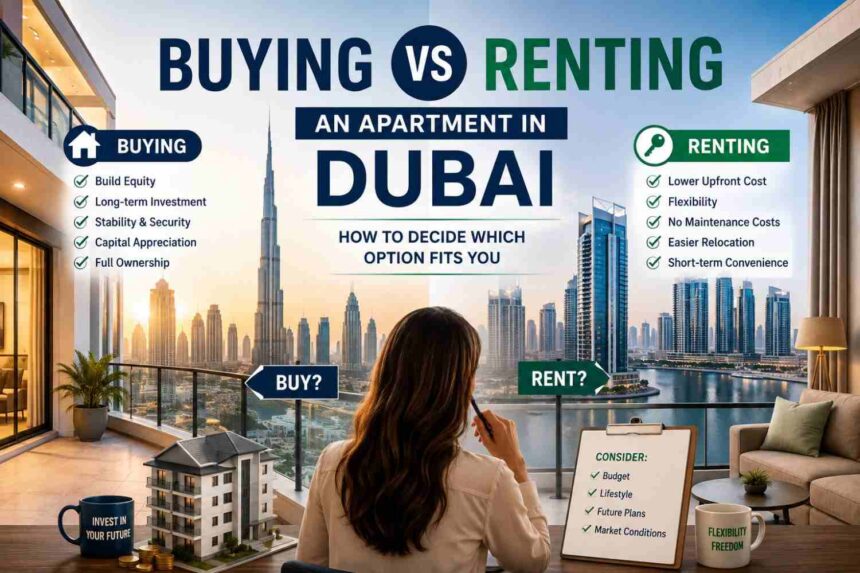
Dubai’s residential market gives people an unusual degree of flexibility when it comes to choosing where and how they want to live. From high-rise apartments in established waterfront communities to residences in newer master-planned developments, there are options for a wide range of lifestyles and budgets.
That variety also creates an important decision for anyone planning to live in the city: should you buy an apartment or rent one?
There is no universal answer.
The better choice depends on how long you expect to stay in Dubai, your available capital, preferred location, lifestyle requirements and expectations around the property market. Someone moving to the city for the first time may benefit from renting before committing to a purchase, while a long-term resident with sufficient capital may find ownership more attractive.
Dubai’s real estate market has also matured significantly, giving buyers and tenants a broad selection of established and newly developed communities. This makes it possible to approach the decision strategically rather than treating buying or renting as a purely financial calculation.
Start With Your Expected Length of Stay
The first question to consider is how long you expect to remain in Dubai.
If your plans are uncertain, renting can provide considerably more flexibility. You can experience different communities before deciding where you ultimately want to settle.
For example, someone may initially rent in Downtown Dubai because of its central location and later decide that Dubai Marina, Dubai Hills Estate or another community better matches their lifestyle.
On the other hand, if you expect to remain in Dubai for many years, purchasing may become more compelling.
A longer holding period gives you more time to benefit from the ownership of the property while spreading the upfront transaction costs across a longer period.
This makes the expected duration of your stay one of the most useful starting points for the decision.
Renting Provides More Flexibility
One of the biggest advantages of renting is mobility.
Tenants can generally change homes without having to sell a property first.
This can be particularly valuable for:
- New residents
- Expatriate professionals
- People with changing work locations
- Families expecting lifestyle changes
- Buyers waiting for the right property
- Investors who don’t want to commit capital immediately
Renting can also allow you to test a neighbourhood.
You might think you want to live near the beach, only to discover that commuting from the area is inconvenient. Alternatively, you may find that a community you initially overlooked provides a better combination of amenities, accessibility and lifestyle.
A rental contract can provide the opportunity to learn these things before making a much larger financial commitment.
Buying Provides Greater Control
Ownership offers a different set of advantages.
When you own your home, you have considerably more control over the property.
Subject to applicable rules and building regulations, owners can generally undertake renovations, change interiors and furnish the apartment according to their preferences.
Ownership can also provide greater certainty for long-term residents.
Instead of renewing a tenancy and potentially facing changing rental costs, homeowners have greater control over their housing arrangement.
This can be particularly attractive for people who already know which community they want to call home.
Understand the Upfront Financial Commitment
Buying an apartment requires more capital at the beginning.
The purchase price is only one part of the calculation. Buyers also need to account for applicable transaction and registration costs, financing expenses where relevant, furnishing and potential renovation.
For this reason, buyers should avoid comparing their mortgage payment directly with monthly rent without considering the full cost of ownership.
A proper comparison should include all major costs associated with purchasing and maintaining the property.
Renting generally requires less capital upfront, allowing tenants to retain more of their money for investments, business activities or other financial priorities.
That liquidity can itself have value.
Compare the Total Cost, Not Just the Monthly Payment
A common mistake is to ask:
“Is my mortgage cheaper than rent?”
The better question is:
“What is the total cost of each option over the period I expect to live in the property?”
For ownership, consider:
- Purchase price
- Down payment
- Financing costs
- Registration and transaction expenses
- Service charges
- Maintenance
- Insurance
- Renovation
- Furnishing
- Opportunity cost of invested capital
For renting, consider:
- Annual rent
- Security deposit
- Agency fees where applicable
- Utilities
- Moving expenses
- Rent increases
- Furnishing costs
Once these factors are included, the comparison can look very different from a simple rent-versus-mortgage calculation.
Location Can Change the Calculation
Dubai has a diverse residential landscape.
The economics of buying versus renting can differ significantly between communities.
A premium waterfront apartment may have a very different purchase price and rental profile from a residence in a developing suburban area.
Similarly, established central communities may have strong tenant demand because of their proximity to employment, entertainment and transport.
This means buyers should conduct the analysis at the community and property level, rather than relying on Dubai-wide averages.
What to Look for When Buying
For people researching Apartments for sale in Dubai, the sheer number of available properties can make the search overwhelming.
The first step should be identifying the characteristics that matter most.
Consider:
Location
Does the community suit your lifestyle and commute?
Building quality
Is the development well maintained and professionally managed?
Apartment layout
Does the space work for your household?
Views
Does the apartment offer a desirable and potentially lasting outlook?
Amenities
Are the facilities useful and well maintained?
Service charges
Are ongoing costs reasonable relative to the property?
Resale potential
Would the apartment remain attractive to other buyers if you eventually sell?
These considerations can help narrow the market considerably.
Don’t Underestimate Service Charges
Apartment ownership comes with ongoing costs that tenants may not directly encounter.
Service charges can cover the maintenance of shared facilities, common areas, security, landscaping and other building-related expenses.
The amount can vary depending on the development and its facilities.
A building with extensive pools, gyms, landscaped areas and concierge services may have higher recurring costs than a simpler development.
This doesn’t automatically make it a poor investment.
The key is understanding what you’re paying for and incorporating the expense into your long-term calculation.
Building Quality Can Affect Both Ownership and Rental Demand
Whether you are buying for yourself or as an investment, the building itself matters.
Look at:
- Age
- Maintenance standards
- Lift condition
- Lobby quality
- Security
- Parking
- Facilities
- Property management
- Common-area cleanliness
Two apartments with similar sizes in the same neighbourhood can have very different values because of the buildings in which they are located.
A well-managed building can contribute to stronger tenant satisfaction and potentially better resale appeal.
Renting Can Be a Strategic Choice
Renting is sometimes viewed as the less financially sophisticated option.
That isn’t necessarily true.
For some people, renting is an intentional strategy.
For example, a person who expects to move within two years may prefer not to incur the costs and administrative complexity associated with purchasing and later selling a property.
Someone who wants to maintain liquidity may also prefer renting while investing capital elsewhere.
Another person may rent while waiting for a particular development to be completed.
The right decision depends on the individual’s broader financial and lifestyle objectives.
Consider the Current Rental Market
Dubai’s rental market includes everything from relatively affordable apartments to highly premium residences.
When researching rental apartments in Dubai, tenants should avoid choosing a property based solely on the advertised annual rent.
The effective cost of renting also depends on the building, location, size, furnishing and amenities.
For example, an apartment with a slightly higher annual rent could potentially provide better value if it eliminates a long commute or provides amenities that would otherwise require additional expenses.
Tenants should therefore compare the total lifestyle value of each property.
Think About Your Commute
Commute time is one of the easiest factors to overlook during a property search.
An apartment may look attractive online, but if travelling to work takes significantly longer than expected, the lifestyle benefits can quickly disappear.
Before signing a lease or purchasing a property, consider the actual journey during your normal working hours.
Look at:
- Road access
- Traffic
- Metro access
- Tram connections
- Parking
- Walking distance
- Access to major business districts
The value of convenience should not be underestimated.
Amenities Can Affect the Decision
Apartment buildings in Dubai increasingly compete through their amenities.
Common facilities can include:
- Swimming pools
- Fitness centres
- Children’s play areas
- Residents’ lounges
- Co-working spaces
- Sports facilities
- Concierge services
- Security
For tenants, these amenities can enhance the lifestyle without requiring separate ownership.
For buyers, however, the facilities can also increase service charges.
This creates an important distinction.
A tenant should ask whether the amenities justify the rent.
A buyer should ask whether the amenities justify both the purchase price and the ongoing ownership costs.
Consider Furnishing Requirements
Furnished and unfurnished apartments can produce very different economics.
A furnished rental may be more convenient for someone moving to Dubai temporarily.
An unfurnished apartment may make more sense for a long-term resident who already owns furniture or wants complete control over the interior.
Buyers should similarly consider whether the property requires significant furnishing expenditure after purchase.
Luxury apartments can become considerably more expensive once high-quality furniture, lighting, appliances and decorative elements are included.
Buying Can Offer Long-Term Stability
One of the strongest arguments for ownership is stability.
A homeowner doesn’t have to make a housing decision every time a tenancy contract approaches renewal.
This can be particularly valuable for families who want to establish themselves in a particular community.
Ownership can also allow the property to become part of a broader long-term financial plan.
Depending on market performance and the individual’s circumstances, the property may eventually be sold, rented out or retained as an asset.
However, ownership should not be viewed as guaranteed appreciation.
Real estate markets move through different cycles, and individual properties can perform differently.
Renting Can Reduce Exposure to Property Market Risk
Renting offers another form of flexibility: you aren’t directly exposed to the value fluctuations of the property you live in.
If property values decline, a tenant isn’t carrying an asset that has lost value.
Likewise, if a neighbourhood becomes less desirable, a tenant may have more flexibility to relocate.
The trade-off is that the tenant doesn’t benefit directly from potential capital appreciation either.
This is one of the fundamental differences between the two strategies.
Think About Opportunity Cost
The capital required to buy an apartment could potentially be used elsewhere.
For example, a buyer might choose between:
- Purchasing a home
- Investing in financial assets
- Funding a business
- Retaining cash reserves
- Purchasing another investment property
The appropriate decision depends on the individual’s financial circumstances and risk tolerance.
This is why the buying-versus-renting decision shouldn’t be made solely by comparing rent with mortgage payments.
The opportunity cost of the down payment and other capital requirements should also be considered.
Consider Your Future Housing Needs
Your current requirements may not remain the same.
A single professional may need a one-bedroom apartment today but require additional space after starting a family.
A couple may want to live in the city centre initially but eventually prefer a larger home in a quieter community.
Before buying, consider whether the apartment can accommodate potential changes.
Ask:
- Will the number of occupants change?
- Will you need another bedroom?
- Will you need more storage?
- Will working from home become more important?
- Will school access matter later?
- Will you want outdoor space?
A property that works perfectly today may become unsuitable within a few years.
Evaluate Resale and Exit Options
If you buy, you should always understand your potential exit strategy.
You may eventually decide to sell, rent the property or move into another home.
An apartment with broad market appeal can provide greater flexibility.
Factors that can influence future appeal include:
- Location
- Building reputation
- Layout
- Views
- Floor
- Parking
- Condition
- Service charges
- Nearby amenities
Highly personalised properties can still be excellent homes, but they may appeal to a narrower group of future buyers.
Consider Rental Potential Before Buying
Even if you’re purchasing a property purely as your home, understanding its potential rental demand can be useful.
Circumstances can change.
You may move abroad, relocate within the UAE or decide to upgrade to another property.
An apartment with strong tenant demand gives you another potential option.
This doesn’t mean you should buy purely for rental yield.
Instead, consider rental demand as one component of the property’s overall flexibility.
Don’t Rush Because of Market Headlines
Real estate markets frequently generate headlines about rising prices, increasing rents or changing demand.
These headlines can create pressure to make a quick decision.
But property is a significant commitment.
Rather than reacting to broad market commentary, assess the specific property you are considering.
Look at comparable properties, recent transactions, rental levels, service charges, building quality and location.
The more expensive the purchase, the more important property-specific analysis becomes.
A Simple Decision Framework
A straightforward framework can help clarify the decision.
Renting may make more sense if:
- You expect to stay in Dubai for a relatively short period.
- Your work or lifestyle may require relocation.
- You want to preserve capital.
- You haven’t yet identified your preferred community.
- You want to test different neighbourhoods.
- You prefer flexibility.
Buying may make more sense if:
- You expect to stay for many years.
- You have sufficient capital for the purchase.
- You are comfortable with ongoing ownership costs.
- You have identified a property that meets your long-term needs.
- You value greater control over your home.
- You want the option of eventually renting or selling the property.
Neither list is absolute.
Your individual financial position and objectives should ultimately determine the decision.
The Best Choice Is the One That Matches Your Time Horizon
There is no universal rule that buying is always better than renting.
The answer changes according to the individual’s circumstances.
Someone staying for a year may place an enormous value on flexibility.
Someone planning to build a long-term life in Dubai may place greater value on stability and ownership.
Someone with significant capital may view a property as both a home and an asset.
Someone prioritising liquidity may deliberately choose to rent.
The important thing is to make the decision based on your expected time horizon, financial position and lifestyle rather than assumptions about what everyone else should do.
Final Thoughts
Dubai offers an unusually diverse residential market, which means both buyers and tenants have plenty of choice.
The decision between renting and buying an apartment should therefore begin with the individual’s circumstances rather than a blanket assumption about which option is financially superior.
Renting can provide flexibility, mobility and the ability to experience different communities before committing. Buying can provide greater control, long-term stability and the potential to retain an asset that can later be sold or rented.
Whichever route you choose, evaluate the actual property carefully.
Consider the location, building, layout, amenities, ongoing costs, transport connections and future requirements. If purchasing, assess the property’s resale and rental potential. If renting, consider the full annual cost and the flexibility provided by the tenancy.
Most importantly, avoid making the decision based on a single number.
The right apartment is one that fits your lifestyle today while remaining financially and practically sensible for the period you expect to stay in Dubai.