



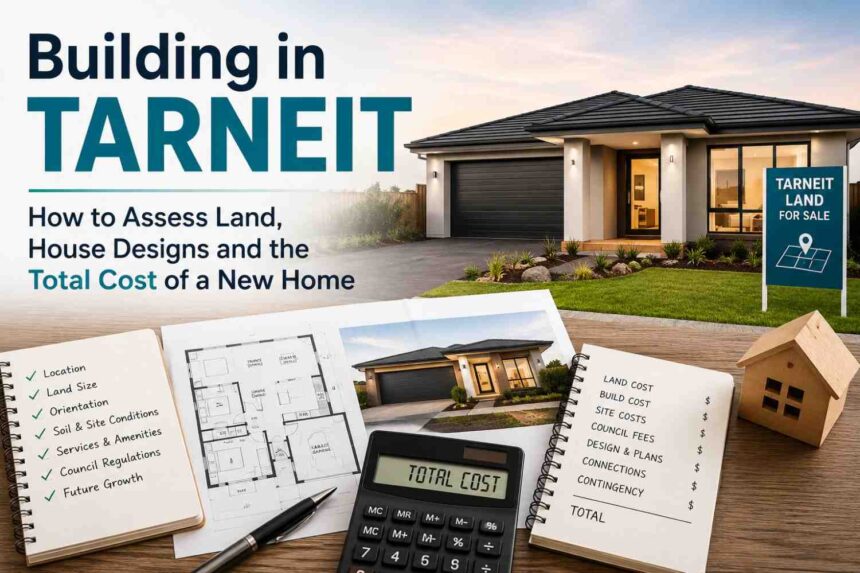
Buying a new home in a growing suburb involves more than comparing house prices. For many buyers, the decision is between purchasing an established property and starting with a block of land and building a home that better reflects their needs.
The latter approach can provide greater control over the final result, but it also requires careful planning. The cost of land is only one part of the equation, while factors such as block orientation, site conditions, construction inclusions and future infrastructure can all influence the final outcome.
Tarneit is a useful example of how buyers can approach this decision. As Melbourne’s western suburbs continue to accommodate population growth, new residential communities are introducing different housing options and creating opportunities for buyers who want to build rather than purchase an established property.
Start by Defining What You Need From the Property
Before comparing blocks or home designs, establish what you actually need from the finished property.
A first-home buyer may prioritise affordability and a manageable mortgage. A growing family might need several bedrooms, a backyard and multiple living areas. An investor could have different priorities, including rental demand, maintenance costs and broad tenant appeal.
The right property will therefore depend on the household rather than a universal checklist.
Consider how many people will live in the home, whether you need a home office, how much outdoor space you are likely to use and whether your requirements could change in the next five or ten years.
This provides a useful framework for assessing both the land and the proposed house.
Understand What You’re Actually Buying
When searching for land for sale in Tarneit, buyers should avoid treating every block as interchangeable.
The characteristics of the land can influence what can ultimately be built and how much construction may cost.
Important factors include:
- Block width and depth
- Orientation
- Slope
- Access
- Easements
- Building restrictions
- Design guidelines
- Site conditions
A block that appears inexpensive may not necessarily produce the lowest overall project cost.
Likewise, paying slightly more for a block with characteristics that better suit your preferred design could potentially make the building process more straightforward.
Block Size Isn’t Everything
It is easy to assume that a larger block automatically provides greater value.
However, usability is often more important than raw land area.
A well-shaped block can provide enough room for a practical home, driveway and outdoor area without requiring unnecessary maintenance.
A larger but awkwardly shaped block may create design limitations or increase landscaping requirements.
Think about what you want the land to achieve rather than simply comparing square metres.
Orientation Can Shape the Home
The direction a block faces can influence natural light, outdoor living and the eventual position of rooms.
Australian homes can benefit from careful consideration of sunlight, particularly when deciding where to position main living areas and outdoor entertaining spaces.
Before selecting a block, consider:
- Where morning sunlight will enter
- Where afternoon sun will fall
- How living areas can be positioned
- Whether outdoor spaces will receive useful light
- How the design can manage summer heat
Your builder or building designer can help determine how the house can respond to the site’s orientation.
House and Land Packages Can Simplify the Process
Building independently gives buyers control over the selection of their builder and design, but it also means coordinating multiple components.
For buyers who prefer a more integrated approach, house and land packages Tarneit can provide an alternative.
A package generally combines a residential block with a proposed home design and construction arrangement. This allows buyers to consider the land and home together rather than trying to determine separately whether a particular design will work on a chosen block.
However, buyers should still examine the details carefully.
Different packages can have substantially different inclusions, specifications and conditions.
Look Beyond the Advertised Package Price
A headline price is useful for comparing options, but it should not be treated as the final cost until the inclusions have been examined.
Depending on the arrangement, buyers may need to account for items such as:
- Site costs
- Landscaping
- Driveways
- Fencing
- Flooring
- Window coverings
- Appliances
- Heating and cooling
- Upgraded fixtures
- Council and statutory costs
Ask for a detailed specification before making comparisons.
A package with a higher advertised price may provide more inclusions than a cheaper package, making the two difficult to compare without examining the details.
Site Costs Deserve Particular Attention
Construction costs can be affected by the physical characteristics of the land.
Soil conditions, drainage, slope and retaining requirements can all influence site preparation.
This is why buyers should ask whether site costs are fixed, estimated or excluded.
Understanding these costs before signing an agreement can help prevent a situation where the initial budget no longer reflects the actual project cost.
Consider the Home’s Long-Term Function
A new home should work for your household today without becoming impractical as your circumstances change.
Think beyond the number of bedrooms.
Consider how people move through the home, whether storage is sufficient and whether living spaces can serve different purposes.
For example, a spare room might initially function as a study and later become a child’s bedroom. A second living area could provide space for children now and become a quieter retreat as the household changes.
Flexibility can be more valuable than simply adding more rooms.
Think Carefully About Outdoor Space
Outdoor areas remain an important part of Australian residential living.
The amount of space you need depends on your lifestyle.
A family with young children may want a backyard with room to play. A household that entertains frequently might prioritise a covered outdoor area. Others may prefer a smaller garden that requires minimal maintenance.
When evaluating land for sale in Tarneit, think about how the block could accommodate the outdoor space you actually want.
There is little benefit in purchasing additional land if you have no intention of using it.
Research the Wider Tarneit Area
A property should never be assessed in isolation.
The surrounding area can influence both lifestyle and future housing demand.
Research access to:
- Schools
- Shopping
- Public transport
- Parks
- Healthcare
- Employment areas
- Major roads
Also consider how the surrounding neighbourhood is expected to develop.
A new community can change considerably as additional homes, infrastructure and amenities are introduced.
Infrastructure Can Change the Daily Experience
Transport infrastructure is particularly important in a growing suburb.
Think about how you and your household will travel on a typical weekday.
A location may appear convenient on a map, but actual travel times can vary considerably depending on traffic and transport availability.
If you commute, test the journey at the times you would normally travel.
If public transport is important, investigate the distance to stations, bus routes and other connections rather than simply assuming that a service described as “nearby” will be convenient.
Schools Should Be Researched Carefully
For families, education is often one of the biggest considerations when selecting a home.
However, proximity alone does not tell the complete story.
Parents should research school catchments, enrolment requirements, transport options and the availability of places.
Catchment boundaries can change, so buyers should confirm current information through the relevant authorities rather than relying on older property listings or informal recommendations.
Look at Parks and Community Facilities
A growing community can offer advantages beyond the home itself.
Parks, playgrounds, walking paths and sporting facilities can contribute significantly to everyday life.
For families, these facilities provide opportunities for children to play and participate in activities close to home.
For other households, walking paths and green spaces can make it easier to exercise and spend time outdoors.
When inspecting potential properties, consider how accessible these facilities are rather than simply whether they exist somewhere in the broader suburb.
Consider the Timing of Your Build
Building a home requires patience.
There can be several stages between securing land and moving into the finished property, including design, approvals, construction and final completion.
The timeline can also be influenced by material availability, builder capacity, weather and site-specific issues.
If you are currently renting, remember to account for your ongoing housing costs during the building period.
A realistic timeline can help you plan your finances and reduce unnecessary pressure.
Keep a Contingency in the Budget
Even a carefully planned construction project can encounter unexpected costs.
A financial buffer can provide protection against changes or expenses that were not apparent at the beginning.
Avoid committing the entire available budget to the land and base construction cost.
There may be features you decide to add later, or practical expenses that emerge as the project progresses.
Maintaining some financial flexibility is particularly important for first-home buyers who may have less experience with construction.
Don’t Overcapitalise on Features
Building a new home creates plenty of opportunities to upgrade.
Premium appliances, elaborate landscaping, high-end finishes and additional rooms can all make a property more attractive to its owner.
But buyers should consider whether every upgrade genuinely improves their lifestyle.
If the additional expense creates financial pressure without providing meaningful everyday benefits, it may not be worthwhile.
The same principle applies if you are thinking about future resale.
A practical, well-designed home generally has broader appeal than a highly personalised property that reflects one owner’s preferences.
Consider Energy Efficiency Early
One advantage of constructing a new home is the ability to incorporate energy-efficient design from the beginning.
Depending on the design and applicable requirements, buyers can consider features such as:
- Effective insulation
- Energy-efficient appliances
- Solar power
- Appropriate window glazing
- Passive solar design
- Efficient heating and cooling
Some measures are easier and cheaper to incorporate during construction than after the home has been completed.
Energy efficiency can also improve indoor comfort while potentially reducing ongoing household energy consumption.
Compare Land and House Packages on Equal Terms
When comparing different options, create a simple cost and features comparison.
Record the land price, construction cost, inclusions, estimated additional costs and expected completion timeline.
Then consider the practical characteristics of each option.
For example, one block might be cheaper but require additional site work. Another might cost more but have a better orientation or require fewer modifications to your preferred home design.
This approach provides a more meaningful comparison than looking at advertised prices alone.
Visit Before Making a Decision
Plans and online listings cannot tell you everything about a location.
Visit the area and explore the surrounding streets.
Pay attention to traffic, noise, construction activity, parks and access to local amenities.
If possible, visit more than once and at different times of the day.
This gives you a better sense of how the area operates during the morning commute, afternoon school period and evening.
Think About the Future Without Relying on Predictions
Growth areas naturally attract forecasts about future property values.
These predictions can be useful as part of research, but they should not form the entire basis of a purchase.
No one can guarantee how property prices will perform.
Instead, focus on fundamentals that are easier to assess:
- Population growth
- Housing supply
- Infrastructure
- Employment
- Amenities
- Transport
- Community planning
These factors provide a more robust foundation for evaluating long-term residential appeal.
Conclusion
Building a new home can give buyers greater control over their living environment, but the process requires more planning than simply selecting a finished property.
Those researching land for sale in Tarneit should assess the block itself, including its orientation, dimensions, site conditions and development requirements. Buyers considering house and land packages Tarneit should go one step further by examining the complete package, including construction specifications, inclusions, additional costs and the suitability of the proposed design.
Ultimately, the strongest decision is not necessarily the cheapest block or the largest house. It is the combination that provides a practical home, a manageable budget and a location capable of supporting your lifestyle over the long term.