



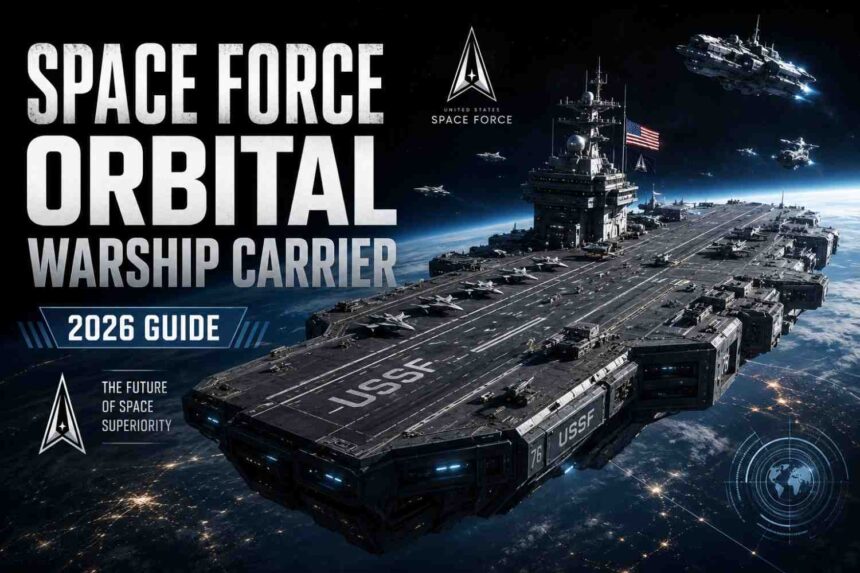
The space force orbital warship carrier – officially just the Orbital Carrier – is an uncrewed platform being built by the company Gravitics to store small spacecraft in orbit and release them quickly when needed. Picture a garage in space that stays loaded and ready.
You probably saw a dramatic headline about a “space aircraft carrier” and want the real story. That’s exactly what this guide gives you: what it is, how it works, and where it stands in 2026.
One quick note before we start. This is an informational explainer based on public reporting and official statements, not defense or legal advice. The program is still in development, so some details may change.
What Is the Space Force Orbital Warship Carrier?
The Orbital Carrier is an uncrewed spacecraft that holds several smaller, maneuverable vehicles inside it and can release them into custom orbits on demand. The Orbital Carrier is designed to pre-position multiple maneuverable space vehicles that can deliver a rapid response to address threats on orbit.
Here’s the naval analogy in plain terms. Instead of launching each mission fresh from a pad on Earth, the carrier waits in orbit already loaded, so it can send a spacecraft where it’s needed within a short window.
The naming gets confusing. Media outlets call it an “orbital aircraft carrier,” a “space aircraft carrier,” and a “warship carrier,” but the official name is simply the Orbital Carrier.
Bust the myth up front: it is uncrewed, carries no aircraft, and is not a Death-Star-style weapon. It’s a satellite deployment and storage platform.
A quick example. If a U.S. spy satellite gets blinded by a laser, a backup craft waiting inside the carrier could be released fast to help keep the mission running.
Who Is Building It and How It Is Funded
Gravitics , a Seattle-area space infrastructure startup, is the prime contractor, working through the Space Force’s SpaceWERX innovation arm.
The funding came in March 2025. Gravitics announced March 26 it received a Strategic Funding Increase, or STRATFI, award from SpaceWERX, the commercial outreach arm of the Space Force, worth up to $60 million. As Gravitics explained in its announcement, that money blends government funds, SBIR small-business grants, and private investment.
CEO Colin Doughan framed the idea simply. He called the Orbital Carrier “a pre-positioned launch pad in space” that lets operators pick a deployment orbit on demand.
There’s a business angle here too. In July 2024, as GeekWire reported, Gravitics won a $125 million contract from Axiom Space to provide a pressurized spacecraft for Axiom’s yet-to-be-launched commercial space station. One company straddling both defense and commercial space shows how the wider space economy is maturing.
Read Also: Micav1: The New Era of Intelligent Automation
How the Orbital Carrier Actually Works
The core idea is deploy-on-demand. Spacecraft sit inside the carrier’s hull and get released into precise orbits without any ground launch.
Based on concept designs, it looks like a satellite-style module that opens in orbit to let smaller craft exit. Concept designs for the carrier show a satellite-style shape that opens in orbit, allowing smaller craft to exit and respond when needed. Payloads stored inside stay shielded from radiation, extreme temperature swings, and micrometeoroids.
In November 2025, Gravitics unveiled a smaller prototype called Diamondback. Gravitics unveiled Diamondback, a smaller orbital carrier designed to fulfill missions from protecting US national security satellites to deploying space-based missile interceptors, on Tuesday at Payload’s Space Investor Summit. It’s meant to prove the deployment tech before larger builds, and Gravitics targets 2027 for its first flight.
Why does skipping a ground launch matter? A normal launch needs a rocket, a pad slot, and good weather, plus weeks or months of planning.
| Factor | Traditional Ground Launch | Orbital Carrier |
|---|---|---|
| Response time | Weeks to months | Hours (once in orbit) |
| Weather dependence | High – delays are common | None after deployment |
| Positioning flexibility | Fixed launch windows | On-demand orbit selection |
| Maturity/status | Proven, routine | Prototype and demonstration phase |
Why the Space Force Wants It: The Threat Picture
The carrier exists to give the U.S. a fast, flexible way to protect and replace satellites as rivals build anti-satellite weapons.
“Dogfighting in space” is the phrase that made news. In 2024, U.S. tracking systems watched Chinese satellites maneuvering around one another. “With our commercial assets, we have observed five different objects in space maneuvering in and out and around each other in synchronicity and in control,” Vice Chief of Space Operations Gen. Michael Guetlein said. “That’s what we call dogfighting in space. They are practicing tactics, techniques and procedures to do on-orbit space operations from one satellite to another.” You can read the full account at Defense News.
The threats go wider than maneuvering. Guetlein cited the deployment of jammers to disrupt satellite signals, the ability to dazzle intelligence surveillance and reconnaissance satellites with lasers, as well as maneuvers involving grappling with a satellite and towing it to a different orbit.
This connects to the Space Force’s push for “tactically responsive space.” The Space Force’s Victus Nox mission demonstrated rapid launch capabilities getting a satellite from warehouse to orbit in just 27 hours. The Orbital Carrier aims to shrink that response even further.
Picture this scenario. A satellite in a key constellation gets damaged. Instead of waiting months for a replacement launch, a fresh craft is released from the carrier in hours.
Is It a Weapon? The Outer Space Treaty Question
The Orbital Carrier is designed as a deployment platform, not an offensive weapon. That said, its capabilities raise fair legal and policy questions.
Start with the rulebook. The 1967 Outer Space Treaty bans placing nuclear weapons or other weapons of mass destruction in orbit. It does not ban all military activity in space.
That gap matters. The Outer Space Treaty of 1967 prohibits nuclear weapons in space but doesn’t specifically address conventional military systems. Space warfare analysts point out this legal ambiguity as nations develop orbital platforms with dual-use capabilities. Programs like this operate in a gray zone, not a clear violation.
Countries including France, members of the EU, and India have pushed for clearer rules to keep space peaceful.
Here’s a common mistake to avoid: assuming “warship carrier” automatically means the project breaks international law. The treaty targets weapons of mass destruction, so a platform that stores and releases conventional spacecraft doesn’t cross that line by itself.
Costs, Hurdles, and What Could Go Wrong
The biggest challenges are cost, technical reliability, and the risk that the carrier becomes one large, high-value target.
Start with money. The up-to-$60 million STRATFI award is development funding. A full operational system would likely cost far more and might need several launches to build out a fleet.
The engineering is hard, too. A carrier must survive years of radiation and vacuum, handle real-time command decisions, carry enough propulsion for big orbit changes, and possibly support on-orbit servicing.
Then there’s the single-point-of-failure problem. A carrier holding many spacecraft is a tempting target, so its own defense and concealment matter as much as its payloads.
Gravitics’ answer is to spread the risk. Gravitics envisions Diamondback as part of a federated fleet, where multiple carriers stationed across different orbits provide global coverage and redundancy. More carriers mean no single loss cripples the whole system.
Where the Program Stands in 2026
As of mid-2026, the Orbital Carrier is in the prototype-and-demonstration phase, with an orbital demonstration targeted this year.
The timeline so far is short and clear:
- March 2025 – Gravitics wins the STRATFI award and begins detailed design.
- November 2025 – The Diamondback prototype is revealed at Payload’s Space Investor Summit.
- 2026 – First orbital demonstration planned.
If the test succeeds, operational capability could follow within a few years, though that timing isn’t guaranteed. Several details stay private too, including exact payload capacity, how larger carriers would be assembled, and the servicing approach.
For readers watching the space economy, the signal is bigger than one product. It reflects a shift toward permanent, responsive platforms in orbit and closer public-private partnerships. Technologically, Diamondback reflects a broader shift toward modular and distributed space architectures. Rather than relying on a small number of exquisite, high-value satellites, this approach favors many smaller, networked platforms that can be repositioned or replenished as conditions change.
For More Quality Content
Space technology moves fast, and the Orbital Carrier is one program worth following as it moves from prototype to orbit. We’ll keep tracking the milestones as they land.
The Bottom Line
Treat the Orbital Carrier as a real, funded, early-stage program – not a finished space battleship and not science fiction. The single clearest thing to watch next is the 2026 orbital demonstration, since a successful test is what turns this from concept into capability.
Want to stay ahead of stories like this? Bookmark this page, and subscribe to the Write Whiz newsletter for plain-English breakdowns of the tech shaping tomorrow.
FAQ
What is the Space Force orbital warship carrier?
It’s an uncrewed platform, officially the Orbital Carrier, built by Gravitics to store small spacecraft in orbit and release them quickly on demand. It works like a pre-positioned garage in space rather than a crewed warship.
Is the orbital carrier real or science fiction?
It’s real and in active development. Gravitics secured a $60 million STRATFI contract in March 2025, the Diamondback prototype was unveiled in November 2025, and an orbital demonstration is planned for 2026.
How much does the orbital carrier cost?
The program received a STRATFI award worth up to $60 million for development. A full operational system would cost considerably more, and those figures haven’t been made public.
When will the orbital carrier launch?
An orbital demonstration is targeted for 2026, and Gravitics lists 2027 for Diamondback’s first flight. Operational capability could follow within a few years of a successful test.
Is the orbital carrier a weapon?
It’s designed as a deployment platform that stores and releases spacecraft, not as an offensive weapon. Because those spacecraft could include defensive tools like jammers or interceptors, its capabilities do raise legitimate policy questions.
Does the orbital carrier violate the Outer Space Treaty?
Not clearly. The 1967 treaty bans weapons of mass destruction in orbit but doesn’t ban conventional military platforms, so the carrier sits in a legal gray area rather than a clear violation.
Who is building the Space Force orbital carrier?
Gravitics, a Seattle-area space infrastructure startup, is the prime contractor. It’s funded and overseen through SpaceWERX, the innovation arm of the U.S. Space Force.
Why does the Space Force need it?
Rivals are building anti-satellite tools, from jammers and lasers to maneuvering “dogfighting” satellites. The carrier gives the U.S. a way to protect and replace satellites in hours rather than months, part of a wider push for tactically responsive space.
For more quality, informative content, visit writewhiz.