



If you searched for credit repair Huntington Beach, here’s the honest answer: it’s legal in California, and it means formally disputing inaccurate, outdated, or unverifiable items on your credit reports. No honest company can guarantee a score or erase accurate negative information.
This article is general information, not legal or financial advice. Confirm the details for your own situation before you act.
Your credit follows you all over Orange County. It decides whether you land that coastal rental, the deposit a utility asks for, the rate on an auto loan, and whether a mortgage underwriter says yes. You’re likely worried, short on time, and wary of getting ripped off. That’s fair. This guide walks you through what credit repair really is, what it costs, the laws that protect you, and how to spot a scam.
What Credit Repair Actually Means in Huntington Beach
Credit repair is the process of reviewing your three credit reports and formally disputing items that are inaccurate, outdated, or unverifiable with the credit bureaus. That’s the whole job. It’s a documentation process, not a magic trick.
What it is not matters just as much. It can’t legally remove accurate, current, verifiable negative marks, and it won’t hack your score overnight.
You have three reports to check, one each from Experian , Equifax and TransUnion. They don’t always match, and errors on any one can cost you.
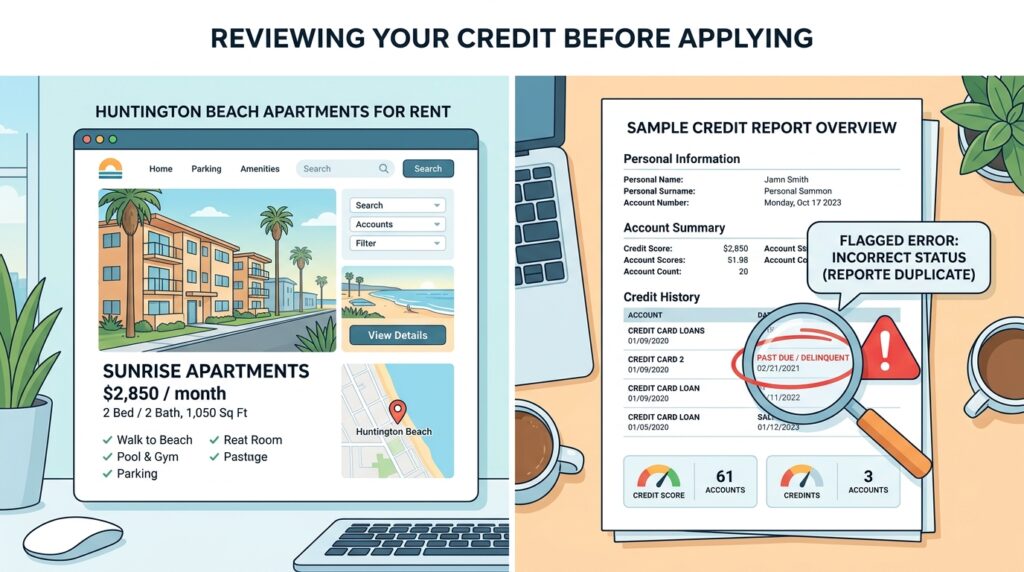
Picture a renter in Huntington Beach applying for a two-bedroom near the pier. The landlord pulls her report and spots a late payment she actually paid on time years ago. She loses the unit to another applicant. That single stale error, not her real finances, closed the door. Fixing it is exactly what credit repair is for.
Is Credit Repair Legal in California?
Yes. Credit repair is legal in California and regulated at both the federal and state level, so honest help is available and dishonest operators are breaking the law.
The federal law is the Credit Repair Organizations Act (CROA), codified at 15 U.S.C. 1679 et seq. As the FTC explains, the Act prohibits untrue or misleading representations, bars companies from demanding advance payment, requires that credit repair contracts be in writing, and gives consumers certain contract cancellation rights. That cancellation window runs three business days.
California stacks a stricter layer on top. Under the California Credit Services Act of 1984 (Civil Code 1789.10 et seq.), a company must register with the state and, as the statute requires, post a $100,000 surety bond before doing business. The state keeps a public list of registered organizations, so you can check a company before you sign.
You also get help from the California Consumer Credit Reporting Agencies Act (CCRAA). And remember, you can do all of this yourself for free.
How the Credit Repair Process Works, Step by Step
Credit repair is documentation-driven and procedural, not a shortcut. Here’s the path.
- Pull all three reports free at AnnualCreditReport.com.
- Review each line for mistakes.
- File written disputes with the bureaus.
- Wait for the investigation. Bureaus generally get 30 to 45 days.
- Track responses and correct or escalate anything unresolved.
- Build habits that keep your score healthy.
Common errors worth hunting for include accounts that aren’t yours, duplicate entries, wrong balances or credit limits, outdated negatives, and late payments you never actually missed.
Say a Huntington Beach buyer named David Nguyen finds a collection account on his TransUnion report that belongs to a different David Nguyen. He disputes it with proof of his own identity, the furnisher can’t verify it against him, and it comes off. That’s a textbook win.
Under the Fair Credit Reporting Act (FCRA), that investigation is your right, and it costs nothing.
Read Also: PostPlace.co.uk Review
How Much Does Credit Repair Cost in Huntington Beach?
Most local firms bill monthly, and CROA plus California law forbid charging you before the work is done. According to Experian’s guidance, companies typically charge a monthly subscription that can range from $50 to $150, and some add an initial setup fee of $70 to $200 after they establish your account.
Price tracks the complexity of your file, not just your score. Here’s how the common models compare.
| Model | How It Works | Typical Range | Watch Out For |
|---|---|---|---|
| Monthly subscription | Pay each month for ongoing disputes | $50-$150/mo | Fees continue even if progress stalls |
| Per-deletion fee | Pay when an item is removed | Varies per item | Costs add up on large files |
| Flat-rate package | One capped price for a defined scope | Often $1,000-$2,000 | Confirm exactly what’s covered |
| DIY (self-dispute) | You file everything yourself | Free | Your time and persistence |
Never pay a large upfront fee. Any pay first, pay per deletion before results, or instant fix pitch is a legal red flag.
If you have just one or two clear errors, a $100 monthly plan for six months costs $600, while doing it yourself costs postage. For a couple of simple mistakes, DIY usually wins.
DIY vs. Hiring a Pro: Which Is Right for You?
You have the legal right to repair your own credit for free, so hiring a pro mostly makes sense when your file is complex or you’re out of time.
DIY fits simple, clear-cut errors. A reputable firm earns its fee when you’re juggling multiple disputes, identity-theft accounts, or furnisher pushback, because it brings knowledge of consumer law and a repeatable dispute strategy.
Before you hire anyone, ask four things:
- Fees and billing – Exactly what do you pay, and when?
- Contract – Is everything in writing?
- Progress – How and how often will they update you?
- Your rights – Can they explain your CROA rights clearly?
A busy Newport-area buyer racing toward a mortgage may happily pay to have it handled. Someone fixing one wrong late payment probably shouldn’t.
Read Also: Investment
Red Flags: How to Spot a Credit Repair Scam
The clearest warning signs map directly to broken laws. If you see any of these, walk away.
- Demands payment upfront (a CROA violation)
- Guarantees a specific score jump (illegal outcome promise)
- Tells you to create a “new credit identity” or use a CPN (fraud)
- Advises disputing accurate information
- Discourages you from contacting the bureaus yourself
- Won’t provide a written contract
Each one signals trouble. As Bankrate notes, the CROA bans upfront payments, and credit repair companies must fully perform a service before requesting payment. The California Credit Services Act carries similar bans and can treat violations as a misdemeanor.
Consider Maria, a Huntington Beach nurse cold-called by a “specialist” promising a 720 score in 30 days for $900 wired that afternoon. She recognized the guarantee and the upfront demand as illegal and hung up. Good instinct.
If you get burned, report it to the FTC at reportfraud.ftc.gov and to the California Attorney General’s office.
Read Also: Space Force Orbital Warship Carrier
What To Do Next
Start free, and start today. Pull your three reports at AnnualCreditReport.com, read every line, and dispute anything wrong yourself before you pay a soul. If your file is tangled with identity theft or stubborn furnishers, then vet a registered, CROA-compliant firm using the four questions above. Either way, you now know your rights, and that’s the part scammers count on you not having.
FAQ
Is credit repair legal in Huntington Beach?
Yes. It’s legal under the federal CROA and the California Credit Services Act of 1984. The key caveat: it can only fix inaccurate, outdated, or unverifiable items, never accurate negative history.
How long does credit repair take?
Bureaus generally have 30 to 45 days to investigate each dispute. Realistic full results often take a few months to a year, depending on your file. Any company promising instant results is misleading you.
Can a credit repair company remove negative items?
Only inaccurate, outdated, or unverifiable ones. Accurate negatives stay, generally up to seven years, and most bankruptcies up to ten years. No company can legally erase truthful, current information.
Does disputing errors hurt my credit?
No. Disputing inaccurate information is your legal right under the FCRA, and filing a dispute does not lower your score. If anything, correcting an error can help.
How much should credit repair cost in Huntington Beach?
Monthly plans commonly run $50 to $150, sometimes with a setup fee charged after work begins. By law, no legitimate company charges you in full before performing the service.
Is it better to use a local Huntington Beach company or a national one?
Location matters less than compliance. What counts is that the company follows CROA and California law, registers with the state, uses a written contract, and is transparent about fees and progress.
Can credit repair help me buy a home in Orange County?
It can clean up report errors before you apply, which may help your rate. It’s not a shortcut to approval, though, and timing matters, so start well before you shop for a mortgage.
Where can I report a credit repair scam in California?
File with the FTC at reportfraud.ftc.gov and the California Attorney General’s office. You can also check any company against the state’s free list of registered credit services organizations.
For more quality, informative content, visit writewhiz.