


You spotted sagerne in a subtitle, a Danish document, or a search result, and you want a plain answer. Sagerne is a Danish word that means“the cases,” “the matters,” or “the issues,” and it is the definite plural of the noun sag. You are in the right place, and no, it is not a celebrity or a hidden brand.
One quick note before we dig in. This is a general language and culture explainer, not legal advice, and the best English translation always depends on the sentence around the word.
What Does Sagerne Mean?
Sagerne means “the cases,” “the matters,” or “the issues” in English. It is the definite plural form of the Danish noun sag, so it points to specific matters already known in the conversation, not just any cases in general.
The base word sag is flexible. It comes from the noun sag, which can mean case, matter, issue, affair, or lawsuit. English tends to split those ideas into separate words, while Danish packs them into one. Wiktionary lists sagerne as the definite plural of sag, and the authoritative Den Danske Ordbog on ordnet.dk records the same range of meanings.
Definiteness is the key. Think of the difference between “we are reviewing cases” and “we are reviewing the cases.” The first is vague; the second points to a known set. That is exactly the job sagerne does. For example: Vi gennemgår sagerne i dag means “We are reviewing the cases today,” and everyone in the room already knows which cases those are.
From Sag to Sagerne: The Grammar Made Simple
Danish builds meaning into the ending of the noun instead of adding a separate word like “the.” One of the most disorienting things about Danish for English speakers is that “the” does not come before the noun. Instead, it is attached to the end. English says “the case.” Danish says “sagen.”
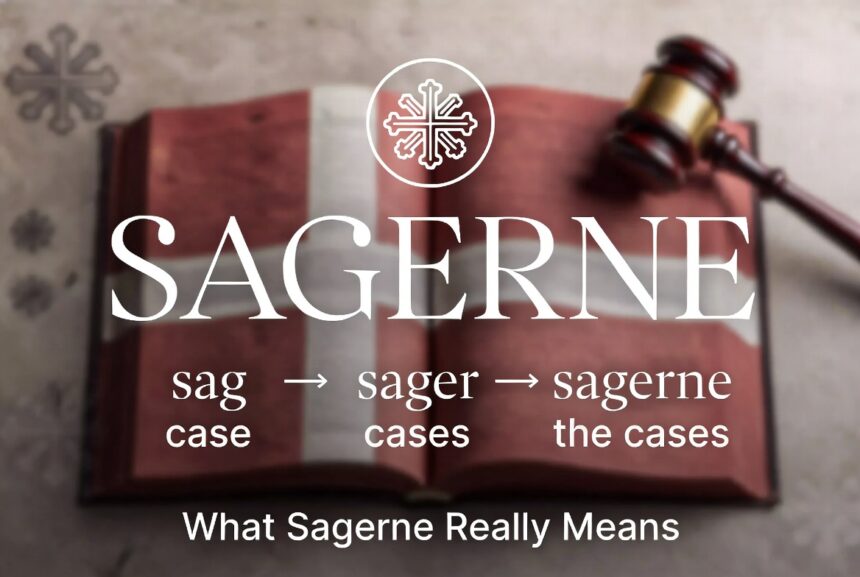
The word moves through four forms. Start with sag (a case), add the plural ending to get sager (cases), then add -ne to mark it as definite, giving you sagerne (the cases). Here is the full picture.
| Danish Form | Type | English Meaning | Example in Use |
|---|---|---|---|
| sag | Singular indefinite | a case / a matter | en vigtig sag (an important matter) |
| sagen | Singular definite | the case / the matter | sagen er lukket (the case is closed) |
| sager | Plural indefinite | cases / matters | mange sager (many cases) |
| sagerne | Plural definite | the cases / the matters | vi løser sagerne (we solve the cases) |
That table answers the question learners ask most: the difference between sag, sagen, sager, and sagerne is simply number and definiteness.
On pronunciation, it sounds roughly like “SAH-uh-neh,” with a soft, glide-like g in the middle rather than a hard one. Wiktionary files it under the Danish rhyme æːɐnə. Danish belongs to the North Germanic language family, so Danish belongs to the same language family as Swedish, Norwegian, Icelandic, and Faroese, all descended from Old Norse.
Read Also: Unlock 10 Powerful Soutaipasu Techniques Today
Sagerne in Legal and Civic Life
In Danish courts, government offices, and journalism, sagerne commonly means “the cases” or “the matters” under review. That is why English searchers so often meet the word in a serious, legal-sounding setting.
Picture a Danish municipal council, or kommune, working through several local disputes at one meeting. Each single dispute is a sag. Taken together, the whole stack on the agenda is sagerne. When a council member says the group must finish sagerne before Friday, everyone already knows which matters that means. The word carries a quiet sense of accountability: these are the things that need attention.
You can see the same pattern in Danish news and podcasts, where sagerne groups the ongoing stories or affairs the public is following. The legal side is easy to confirm through official sources like Denmark’s courts at domstol.dk, which handle exactly the kind of sager the word describes. In Denmark, the word often appears in discussions about legal issues, social debates, and news reports.
Read Also: Ombudsmänner: The Modern Watchdogs of Fairness, Integrity, and Accountability
Does Sagerne Mean “Saws”? Clearing Up the Confusion
No, sagerne does not mean “the saws” in standard Danish. The Danish word for a saw is sav, its indefinite plural is save, and the definite plural is savene, as Wiktionary confirms for sav and for savene.
So where does the “saws” idea come from? It travels across the border. In Norwegian, the word for saw is sag, and Oslo has a borough called Sagene. The name Sagene itself is the plural of the Norwegian word for “saw”, reflecting all the old industrial mechanical saws powered by the river Akerselva in this area in the 19th and early 20th centuries. A reader who sees “Sagene” and “sagerne” close together can easily blur the two, as the Wikipedia entry on Sagene explains.
Several online guides repeat the “saws” claim, so this correction matters. If you truly mean saws in Danish, the word you want is savene, never sagerne.
Why People Are Searching Sagerne Right Now
Curiosity and confusion drive the interest, not fame. An unfamiliar foreign word looks like it could be a name, a brand, or a trend, so people type it into a search bar to find out what it is.
There is a familiar internet pattern at work. There is a familiar internet pattern here. A term starts circulating without context, people assume it may be a person or brand, and then a wave of explainers appears to answer the same basic question from different angles. Many of those explainer articles landed across 2025 and 2026, which pushed the search interest even higher.
Let me set the record straight. There is no verified public person named Sagerne, no registered global brand, and no organized “movement” behind it. Sagerne is a regular Danish word, not a proper noun, brand, company name, or technical term. Its unusual appearance to English eyes causes many readers to mistake it for a name, but it is grammatical vocabulary used in everyday Danish communication.
Cross-border exposure explains the rest. Subtitles on Nordic crime dramas, social feeds, and search results all carry everyday local words to new audiences, where an ordinary noun can suddenly look mysterious.
Read Also: Xaicotum: The Creative Movement Everyone’s Discussing
How to Use Sagerne Correctly (and Common Mistakes)
Pick the English translation that fits the setting. Use “the cases” for legal and police contexts,“the matters” or “the issues” for office and civic talk, and looser wording in casual conversation.
Two quick before-and-after examples show the definite-plural sense in action:
- Jeg arbejder med sager. means “I work with cases,” in a general way.
- Jeg arbejder med sagerne. means “I am working with the cases,” pointing to specific, known ones.
- Chefen diskuterer sagerne med teamet. means “The manager is discussing the matters with the team.”
A few mistakes trip up learners most often:
- Treating sagerne as a general plural. It is always definite, so it means the cases, never just “cases.”
- Translating it as “saws.” That is a different Danish word, savene.
- Assuming it is a brand or a person’s name. It is ordinary vocabulary.
A fast self-check: if you can drop “the” in English and the sentence still works, you probably want sager. If “the” is doing real work, you want sagerne.
The Bottom Line
Treat sagerne as plain Danish grammar, not a mystery. It is the definite plural of sag, so read it as “the cases,” “the matters,” or “the issues,” and let the surrounding sentence choose the exact word.
If you are learning Danish, your best next step is to read a short Danish news piece and spot every -ne ending you can find. The pattern will start to feel natural fast, and you will recognize sagerne on sight.
FAQ
What does sagerne mean in English?
Sagerne means the cases, the matters, or the issues, depending on context. It is the definite plural of the Danish noun sag, so it always points to specific, already-known items rather than cases in general.
Is sagerne a Danish or Norwegian word?
Sagerne is standard Danish, the definite plural of sag. Norwegian handles this differently, and in Norwegian the related word sag actually means “saw,” which is one reason the two languages get confused.
Does sagerne mean saws?
No. Definite plural of sav is savene, which is the Danish word for “the saws.” The mix-up comes from Norwegian, where sag means saw, and from the Oslo borough Sagene, named after old riverside sawmills.
How do you pronounce sagerne?
It sounds roughly like “SAH-uh-neh,” with a soft, glide-like g rather than a hard one. Wiktionary files it under the Danish rhyme æːɐnə, and pronunciation can vary a little by dialect.
What is the difference between sager and sagerne?
Sager is the indefinite plural and means “cases” or “matters” in general. Sagerne is the definite plural and means “the cases” or “the matters,” referring to specific ones already known in the conversation.
Is sagerne a brand, person, or viral movement?
No. It is a normal Danish noun, not a verified public figure, a registered brand, or an organized movement. It simply looks like a name to English eyes because the word is unfamiliar.
Where might I see sagerne used?
You will meet it in Danish legal documents, court and police reporting, municipal records, news articles, and podcasts that follow ongoing cases or issues. It also shows up in everyday office and family conversation about matters people already know.
For more quality, informative content, visit Write Whiz.