



If you searched for “SAE hose clamp size 28 165 332”, here is the short answer: only the “28” is a real specification. It is a standard size of worm-gear hose clamp. The numbers 165 and 332 do not belong to any SAE size 28 specification, and no manufacturer or standards document connects them to this clamp. If you saw them in a listing, they are almost certainly catalogue or part-number fragments, not measurements.
That matters, because buying the wrong clamp means a hose that leaks, slips off, or gets damaged. This guide explains what SAE 28 really is, what its true size range is, and what to do about the “overall length” question — for which, honestly, there is no published specification at all.
What Is an SAE Hose Clamp Size 28?
An SAE size 28 hose clamp is a worm-gear (worm-drive) clamp that fits hoses with an outside diameter of roughly 33 to 57 mm (about 1-5/16 to 2-1/4 inches). It is the size used on many car radiator hoses, coolant hoses, and boat water hoses.
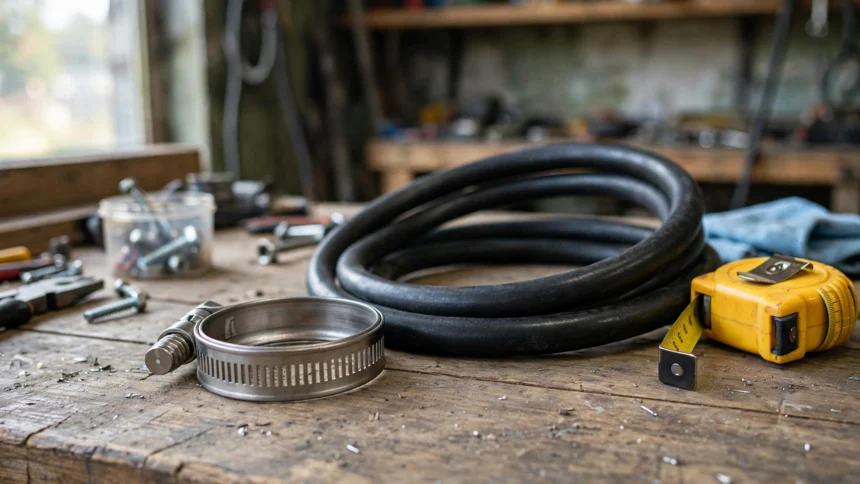
A worm-gear clamp is the common metal band with a screw housing you tighten with a screwdriver or socket. As you turn the screw, the band pulls tight around the hose. The “SAE” part refers to SAE J1508, the standard that defines the clamp sizes. The number 28 is a size code from that standard’s table.
Here is the important part: the number 28 is not a measurement. It is not 28 mm, and it is not 28 inches. It is simply the row in the size table that tells you the clamp’s diameter range. The number that actually matters is the clamping range printed on the packet.
What Do 165 and 332 Mean?
Nothing — at least, nothing to do with a size 28 clamp.
No product listing, spec sheet, or standards document uses “165” and “332” together with SAE size 28. The most likely explanation is that a keyword tool stitched together fragments from a catalogue page. Two coincidences show how easy it is to be misled:
- In the SAE J1508 table, 165.1 mm is the open diameter of SAE size 96 — a much bigger clamp.
- In one catalogue’s part numbering, part 611-332 is a giant clamp for hoses around 19 to 21 inches.
Neither of those has anything to do with a size 28 clamp. So if a listing shows “165” or “332” next to size 28 with no label, treat them as catalogue fragments, not dimensions. What you should check instead is the listing’s stated clamping range.
SAE Size 28: The Real Specifications
Per SAE J1508 (Type F), a size 28 clamp has:
- Clamping range: about 33 to 57 mm (1-5/16 to 2-1/4 inches)
- Open diameter: 2.25 in (57.1 mm)
- Closed diameter: 1.31 in (33.3 mm)
- Band width: 1/2 in (12.7 mm)
- Screw head: 5/16 in slotted hex head (a 7–8 mm socket or nut driver fits)
One thing to know: different sellers state slightly different minimum sizes. Some say 33 mm, others say 40 mm or even 44 mm. That is not a mistake exactly. The 33 mm figure is the clamp’s physical closed diameter. The bigger numbers are makers’ recommended hose-fit ranges — the sizes of hose they suggest you use it on. In practice, buy for the hose size you have, and check the specific maker’s stated range.
What About the Overall Length?
There is no published “overall length” specification for a worm-gear hose clamp — not in SAE J1508, and not in any manufacturer listing we could find. Retailers simply do not list one. So if a page claims a specific overall length for a size 28 clamp, treat it with suspicion.
What the standard does give is the size of the screw housing: roughly 19 mm long and 21 mm wide, with the screw up to about 34 mm long. And the tallest point of a fitted size 28 clamp — measured from the centre of the hose to the top of the screw housing — is about 44.5 mm.
If you genuinely need a length measurement, measure it yourself: lay the clamp flat and open, then measure it end to end. Just know that this number is not a published spec, and it varies between makers because the extra tail length is arbitrary. One listing we saw even showed “band length: 0.5 in” for a size 28 clamp, which is plainly an error — a band cannot be half an inch long. That figure is the band width.
How to Read the Markings on a Hose Clamp
Most clamps are stamped or printed with a size code and a range. Here is how to read them:
- The SAE number (like 28) tells you the size class. It is a code, not a measurement.
- The range (like 33–57 mm) is the number that matters. It tells you the smallest and largest hose outside diameter the clamp fits.
- Part numbers (like HC28 or 710-1121) vary by maker. There is no universal part number for a size 28 clamp.
Always match the clamp to the hose’s outside diameter, measured over the fitting or barb — not the hose’s inside diameter. The outside diameter is what the clamp actually squeezes. A hose’s inside diameter tells you about flow; its outside diameter tells you which clamp fits.
Common Uses for a Size 28 Clamp
Size 28 clamps are general-purpose. You will find them on:
- Car and van radiator and coolant hoses
- Fuel lines and air-intake hoses
- Boat raw-water and exhaust hoses
- Plumbing and garden hose connections
- Farm and workshop hoses
They suit hoses around 1-1/2 to 2 inches in outside diameter. For critical marine connections, such as hoses below the waterline, makers recommend fitting two clamps on each hose end (double-clamping) for safety.
How to Buy the Right One
Measure first. Measure the hose’s outside diameter over the fitting with a tape or calipers. Pick a clamp whose range covers that size with room in the middle — avoid a clamp sitting at the very top or bottom of its range.
Pick the right material for the job. Zinc-plated steel is cheapest and fine for dry indoor use. Stainless steel (304) suits general outdoor and car use. For boats and salt water, go for 316 stainless, which resists corrosion best.
For soft or silicone hoses, choose a non-perforated or embossed band. Standard perforated bands have slots that can cut into soft hose material over time. A smooth or lined band is kinder to the hose.
Tighten to the maker’s torque figure. Torque specs vary by maker for this size, roughly 35 to 60 inch-pounds. Over-tightening can cut the hose or strip the screw, so follow the number on the packet rather than guessing.
Do not trust a bare number. If a listing shows extra numbers like 165 or 332 with no label, they are catalogue fragments, not dimensions. Check the stated clamping range instead — that is the spec that counts.
For help measuring, see the AFT Fasteners hose clamp size chart and Mammoth Performance Parts guide to measuring a hose clamp.
FAQ
What size hose does an SAE 28 clamp fit?
Hoses with an outside diameter of about 33 to 57 mm (1-5/16 to 2-1/4 inches). Measure the hose outside diameter over the fitting, then check that it falls inside the clamp’s stated range.
Is SAE 28 the same as 28 mm?
No. The 28 is a size code from the SAE J1508 standard, not a measurement. The clamp’s actual range is about 33 to 57 mm.
What is the overall length of a size 28 hose clamp?
There is no published overall length spec. If you need a length, lay the clamp flat and open and measure it end to end yourself.
What do 165 and 332 mean in “SAE hose clamp size 28 165 332”?
Nothing verified. No spec sheet or standard connects those numbers to a size 28 clamp. They are most likely catalogue or part-number fragments from a listing.
What screwdriver do I need for a size 28 clamp?
Most use a 5/16-inch slotted hex head, so a flathead screwdriver, a nut driver, or a 7–8 mm socket all work.
Can I use a size 28 clamp on a silicone hose?
Yes, but choose a non-perforated or embossed band so the slots do not cut into the soft hose, and do not over-tighten.
The Bottom Line
SAE size 28 is a standard worm-gear clamp for hoses around 33 to 57 mm in outside diameter. The numbers 165 and 332 in the search phrase are not part of its specification — do not let them confuse a purchase. Measure your hose, match the clamping range, pick the right material, and tighten to the maker’s torque figure. That is all there is to it.
See also: What Is SSIS-469? — another search term that turns out not to mean what it seems.
See also: What Is 3d659.com? — a site whose big claims did not check out.
See also: What Is a Cadibara? — a misspelling that hides a real animal.
Want more plain-English tech explainers? Subscribe to WriteWhiz — new guides every week.