



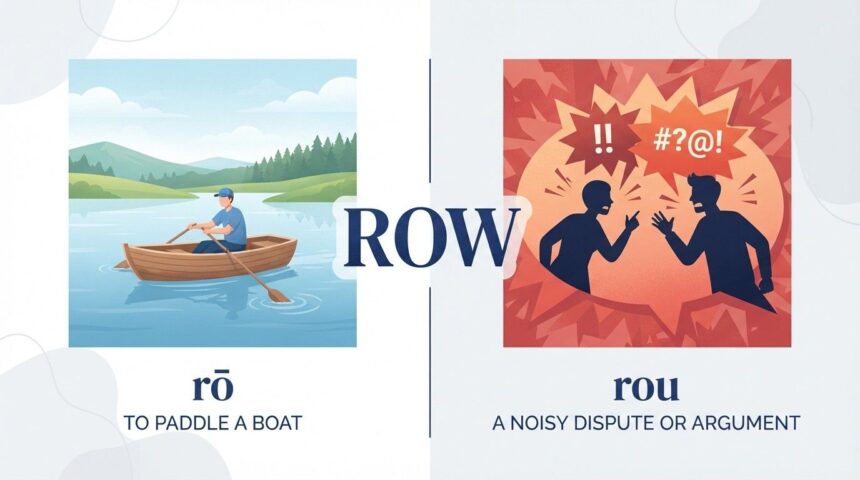
You typed heteronyms row because you hit that word in a headline or a book and paused, unsure how to say it. Here is the quick answer: row is a heteronym, which means it is spelled one way but has two pronunciations and two very different meanings. Say it “roh” (rhymes with go) and it means a line of things or to paddle a boat. Say it so it rhymes with cow and it means a noisy argument.
That is the fast answer. The rest of this guide shows you why it works that way, how to tell which sound to use, and a handful of other words that pull the same trick.
One friendly note before we dig in: the pronunciations here follow general American and British English. Regional accents vary, so a Scottish speaker and a Texan may color these sounds a little differently. When you want the exact audio, a good dictionary is your best friend, and we link a few below.
What Are Heteronyms?
A heteronym is a word that is spelled exactly like another word but is pronounced differently and carries a different meaning. Same letters on the page, two different sounds in your mouth, two separate meanings. Reading is the only place the confusion shows up, because in speech the sound already tells you which one you mean.
The word itself comes from Greek. According to the Online Etymology Dictionary, it joins hetero meaning “different” with -onym meaning “name,” and it entered English in the 1880s. So a heteronym is literally a “different name” hiding inside one spelling.
Two things usually cause this split. The first is a vowel-sound change, like row, lead, and tear. The second is a stress shift, where the emphasis moves between syllables, like REcord (the noun) versus reCORD (the verb).
[Image Placeholder: The word “row” splitting into two paths – one labeled “roh = a line / to paddle” with a rowing boat icon, the other labeled “row (rhymes with cow) = an argument” with a speech-bubble icon.]
One common mix-up: readers often confuse heteronyms with homophones, which are words that sound the same but are spelled differently. We will clear that up in a moment.
How Row Works as a Heteronym
Row has two accepted pronunciations, and each one points to a completely different meaning, so the surrounding words tell you which to use.
The first pronunciation is “roh,” rhyming with go. As a noun it means a straight line of people or things, a horizontal line in a spreadsheet, or a round in knitting. As a verb it means to move a boat with oars. Cambridge gives the boat sense as causing a boat to move through water by pushing against it with oars. Think: “We sat in the front row,” or “Let’s row across the lake.”
The second pronunciation rhymes with cow and now. Here row means a noisy argument or quarrel, and it is mostly British and Irish. You see it constantly in UK news, in phrases like a “planning row” or a “transfer row .” Example: “The couple had a blazing row over money.”
Here is where American readers trip up. A British headline like “Minister sparks row” is not about a line of anything – it means a public fight. Context and region sort it out fast once you know both senses exist.
The origins differ, too. As Merriam-Webster shows, the line-and-paddle senses trace back to Old English (ræw for a line, rowan for paddling), while the argument sense is later British slang. The argument sense is a slang term that came into use around Cambridge University in the mid-1700s, perhaps from the word rousel, meaning a bout of drinking.
| Pronunciation | Part of speech | Meaning | Example sentence |
|---|---|---|---|
| “roh” (rhymes with go) | Noun | A line of people or things | We booked seats in the second row. |
| “roh” (rhymes with go) | Verb | To paddle a boat with oars | They row every morning before work. |
| “row” (rhymes with cow) | Noun | A noisy argument | She had a row with her landlord. |
Heteronyms vs Homographs vs Homophones vs Homonyms
These four terms overlap, so here is the clean version: a heteronym is a specific type of homograph , and it is the opposite of a homophone.
In one plain sentence each:
- Homograph – same spelling (pronunciation may or may not differ).
- Heteronym – same spelling, different sound and meaning.
- Homophone – same sound, different spelling.
- Homonym – an umbrella term for words that share spelling or sound.
Heteronyms represent a subset of homographs, which are words sharing the same spelling regardless of pronunciation or meaning. The key difference is that a heteronym changes how you say it.
Here is a fun twist the word row gives us. Said “roh,” it is a homophone of roe (fish eggs), because they sound identical but are spelled differently. At the very same time, row is a heteronym with itself. So one little word plays two of these games at once – a handy thing to remember when the labels blur.
| Term | What stays the same | What differs | Quick example |
|---|---|---|---|
| Homograph | Spelling | Meaning (sometimes sound) | bass (fish / low sound) |
| Heteronym | Spelling | Sound and meaning | row / row |
| Homophone | Sound | Spelling and meaning | row / roe |
| Homonym | Spelling or sound | Meaning | bat (animal / stick) |
More Heteronyms Like Row: Bow, Sow, Wind, Lead, Tear
Row belongs to a small, famous club of one-word heteronyms where a single vowel flips the whole meaning. Once you spot the pattern, these get easy.
Walk through the classics. Bow (“boh”) is a knot or a weapon; bow (“bow,” like cow) is to bend forward. Sow (“soh”) means to plant seeds; sow (“sow,” rhymes with cow) is a female pig. Wind (“wind,” short i) is moving air; wind (“wined,” long i) means to twist. Lead (“leed”) means to guide; lead (“led”) is the metal. Tear (“teer”) is a drop from your eye; tear (“tair”) means to rip. Close, meaning “near,” and close, meaning “shut,” are heteronyms, and tear, meaning “rip,” and tear, the drop that slides down your cheek, are heteronyms too.
There is also a stress-shift family worth knowing. As The Grammarphobia Blog explains, words like present, record, permit, conduct, and produce put the stress on the first syllable as nouns and the second syllable as verbs. You PREsent a PREsent by choosing to preSENT it.
| Word | Pronunciation 1 + meaning | Pronunciation 2 + meaning |
|---|---|---|
| row | “roh” – a line / to paddle | “row” (like cow) – an argument |
| bow | “boh” – a knot or weapon | “bow” (like cow) – to bend |
| sow | “soh” – to plant seeds | “sow” (like cow) – female pig |
| wind | “wind” – moving air | “wined” – to twist |
| lead | “leed” – to guide | “led” – the metal |
| tear | “teer” – a drop from the eye | “tair” – to rip |
How to Know Which Pronunciation to Use
Context is your reliable guide. The words around it and the meaning of the sentence tell you which pronunciation the writer intended, almost every time.
Try this simple three-step trick when you get stuck:
- Check the part of speech. Is row acting as a noun, a verb, or something else? A verb near a boat almost always means “roh.”
- Read the whole sentence for meaning. Does it describe a line, a paddle, or a fight? The meaning locks in the sound.
- Note the region. British and Irish headlines lean toward the argument sense of row, so “sparks row” rhymes with cow.
Here is a quick “what if.” Imagine reading aloud: “There was a huge row over the seating row.” Both pronunciations appear in one sentence – the argument “row” first, the line “row” second. Say it out loud and you can hear the two lives of the word.
When you are truly unsure, listen. Dictionaries show pronunciation with respelling or IPA plus an audio button. The Cambridge Dictionary and Merriam-Webster both let you tap and hear each version, which settles the question in seconds.
The Bottom Line
Treat row as your permanent reminder that English spelling and sound do not always march together – so read for meaning first, then pick the sound. Next time a heteronym stops you cold, run the three-step check above, or tap the audio button in a trusted dictionary and move on with confidence.
For more quality, informative content, visit Write Whiz.
FAQ
Is row a heteronym or a homonym?
Row is a heteronym, which is a specific type of homograph. It is spelled one way but has two pronunciations (“roh” and “row” like cow) and two meanings. “Homonym” is a broader umbrella term, so calling row a heteronym is the more precise answer.
How do you pronounce row when it means an argument?
When row means a quarrel, it rhymes with cow and now. “Row” meaning “argument” is indeed pronounced like “cow.” For example: “They had a loud row in the kitchen.”
What is the difference between a heteronym and a homophone?
A heteronym is spelled the same but sounds different, like row (a line) versus row (an argument). A homophone sounds the same but is spelled differently, like row (“roh”) versus roe (fish eggs). Same spelling versus same sound is the dividing line.
What are 5 examples of heteronyms besides row?
Five easy ones are bow (knot / bend), sow (plant seeds / female pig), wind (moving air / to twist), lead (to guide / the metal), and tear (eye drop / to rip). Each changes meaning when you change the vowel sound.
Why does the word wind have two pronunciations?
Wind splits by a vowel change. With a short i it is a noun for moving air (“the wind is strong”). With a long “i” it is a verb meaning to twist or wrap, as in “wind your watch.” Same letters, two sounds, two jobs.
Are heteronyms and heterographs the same thing?
No. Heteronyms share the same spelling with different sounds and meanings. Heterographs are words that are spelled differently but often sound alike, like to, too, and two. The prefixes look similar, but the two ideas are opposites.
Is “row” an argument in American English too?
The argument sense exists in American English but is far less common there. American English tends to call a row a fight. Americans usually say fight or argument, so the “row” spelling for a quarrel reads as mainly British and Irish.