


If you searched for “SAE hose clamp size 28 165 332 overall length”, here is the honest answer up front: there is no published “overall length” spec for a worm-gear hose clamp. No maker lists one, and SAE J1508 does not include one either. The numbers 165 and 332 do not belong to size 28 at all. They belong to two much bigger clamps. This article explains what each number really means, what “length” can mean for a hose clamp, and how to measure one yourself.
There Is No “Overall Length” Spec
A worm-gear hose clamp is a metal band that wraps around a hose, tightened by a screw. Unlike a bolt, which has a clear length, a clamp’s band changes length as it opens and closes. That is why no catalogue lists an “overall length” for it.
SAE J1508, the standard that defines these clamps, lists exactly two things per size in its Table 6 for Type F clamps: a diameter range (open and closed) and a radius dimension called “R over screw”, which is footnoted as a reference dimension for clearance only. It is not a length spec. Ideal-Tridon, Breeze, and other makers’ catalogues also have no “overall length” or “band length” column.
So if a listing or a search result promises an “overall length” for size 28, treat it with suspicion. It is not a number any maker publishes.
What 165 and 332 Actually Mean
The search string “28 165 332” mashes together three different clamps:
28 is the clamp you are asking about. SAE size 28 is a small-to-medium worm-gear clamp. Its diameter range is about 33 to 57 mm. See the full size 28 spec table in our companion article.
165 is size 96’s open diameter. In SAE J1508, size 96 opens to 165.1 mm (6.50 inches). That is a big clamp, roughly three times the size of a size 28. It has nothing to do with size 28.
332 is a clamp size, not a dimension of size 28. Part numbers like 611-332 are distributor codes for a size 332 clamp. Clamp makers use the last two or three digits of a part number to show the size, so 332 means size 332. A size 332 clamp fits hoses around 486 to 540 mm across — roughly half a metre. It is a giant clamp for industrial hoses, not a measurement of a size 28.
In short: 28, 165, and 332 are three separate clamps. Searching for them together only creates confusion.
What “Length” Can Mean for a Hose Clamp
Even though there is no official overall-length spec, a clamp does have lengths you can talk about:
Band width. This is a real spec, but it depends on the clamp family rather than the SAE size number. Standard worm-gear clamps usually have a 1/2 inch (12.7 mm) band. Heavy-duty versions use 9/16 inch (14.2 mm), and mini clamps use 5/16 inch (8 mm). Band width matters because it decides how much surface presses on the hose. A narrow band digs in; a band that is too wide can bridge over a curved fitting instead of sealing.
Band length, which is really a circumference. The band is a strip of metal. When the clamp is closed, the strip overlaps itself at the screw housing. When it is open, the strip stretches out. So the “length” of the band is really the circumference of the circle it forms, and it changes as you tighten or loosen the screw.
R over screw. This SAE dimension is a clearance radius, not a length. Do not mistake it for an overall length.
How to Measure a Hose Clamp’s Length Yourself
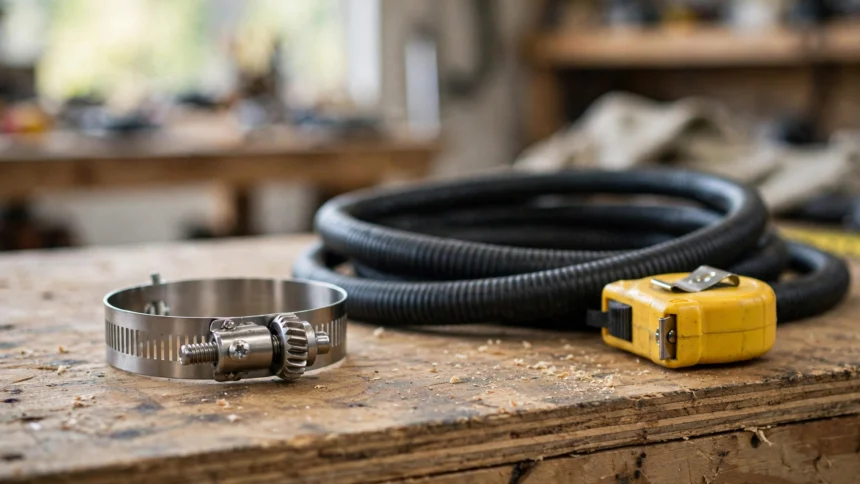
Since no maker publishes this number, here is how to measure it. You only need a tape measure.
- Loosen the screw fully and unroll the band as far as it will go.
- Measure from the very tip of the band to the point where the threads start to grip the housing. That gives you the clamp’s maximum circumference.
- Divide that number by 3.14159 (pi) to get the maximum diameter the clamp can reach.
- Measure the band width across the strip. This tells you whether it is a standard, heavy-duty, or mini clamp.
One warning: the physical strip is longer than pi times the diameter, because part of it sits inside the housing and overlaps, plus a tail end sticks out. So the band length is not one clean number. The circumference at a given diameter is the honest figure.
As an example, here is some arithmetic, not a maker spec: a size 28 clamp opens to 57.1 mm. Multiply by pi and you get about 179 mm, or roughly 7 inches, of circumference at fully open. That is a calculation from the published open diameter. Do not treat it as an official “overall length” for size 28, because no such spec exists.
How to Pick the Right Clamp by Hose Size
The number that actually matters when buying a clamp is the hose’s outside diameter, not the clamp’s length. Here is how to get it right:
- Measure the hose where the clamp will sit, ideally with the hose already pushed onto the fitting. Hoses expand over the barb, so measuring a loose hose gives a smaller number than the real one. Use calipers if you have them. Otherwise, wrap a tape measure around the hose and divide the circumference by pi.
- Pick a clamp whose range covers your measurement with room to spare. Three common rules of thumb all point the same way: put the hose size near the middle of the clamp’s range; or pick a clamp whose maximum is 10 to 15 percent above the hose’s outside diameter; or pick a clamp about 1/2 inch over the pipe diameter. These are rules of thumb, not standards, but they agree on the principle: do not run a clamp at the extreme end of its range.
- Check the band width suits the job. A soft or silicone hose needs a wider, gentler grip, and often a non-perforated band (more on that below).
Common Mistakes to Avoid
Over-tightening. This is the most common failure. Cranking the screw until it will not turn cuts into the hose, especially a soft or silicone one, strips the threads, and can make a leak worse than a loose clamp. Tighten until snug, then add a quarter to half a turn more, and stop. Torque figures vary by maker, so follow the sheet that came with your clamp rather than one universal number.
Sizing at the extreme end of the range. A clamp far too big leaves a long tail sticking out of the housing. The tail snags, chafes nearby hoses and wires, and can cut your hands. A clamp that only just fits grabs the screw with a couple of threads and can fail without warning.
Clamping over the barb lip. The band must sit behind the raised ridge on the fitting, so the ridge presses into the hose wall. Clamping on top of the ridge will not seal.
Using a perforated band on soft hose. Standard worm-gear bands have slots. On soft or silicone hose, the rubber squeezes into the slots and the edges cut through. For soft hose, use a non-perforated or lined clamp, which makers sell for exactly this job.
Wrong band width. A narrow band on a big hose digs a groove. An over-wide band on a small or curved fitting bridges over the curve instead of sealing. Match the width to the job.
Size 28 Numbers at a Glance
For quick reference, here are the size 28 figures that are actually published:
| Dimension | Size 28 |
|---|---|
| Open diameter | 57.1 mm (2.25 in) |
| Closed diameter | 33.3 mm (1.31 in) |
| Band width (standard) | 1/2 in (12.7 mm) |
| Screw | 5/16 in slotted hex head |
One honest caveat: the minimum diameter is stated slightly differently depending on the source. SAE’s mechanical closed diameter is 33.3 mm, some retailer charts say 33 mm, and some maker catalogues list 32 mm. The gap comes from the difference between the mechanical closed size and the smallest hose the clamp is recommended for. The open diameter of 57.1 mm is consistent everywhere.
For the full breakdown of size 28, including where the 165 and 332 confusion comes from in more detail, see our companion article on SAE hose clamp size 28 165 332.
Frequently Asked Questions
What is the overall length of an SAE size 28 hose clamp?
There is no published overall length. Makers and SAE J1508 do not list one. The closest measurable figure is the band’s circumference, which is about 179 mm at fully open by calculation from the published 57.1 mm open diameter — but that is arithmetic, not a maker spec.
What does 165 mean in “28 165 332”?
165.1 mm is the open diameter of SAE size 96, a much bigger clamp. It has nothing to do with size 28.
What does 332 mean in “28 165 332”?
332 is a clamp size. Part numbers like 611-332 identify a size 332 clamp, which fits hoses around 486 to 540 mm across. It is not a dimension of size 28.
How do I measure a hose clamp?
Loosen it fully, unroll the band, and measure from the tip of the band to where the threads grip the housing. That is the maximum circumference. Divide by pi to get the maximum diameter. Also measure the band width.
What size clamp do I need for my hose?
Measure the hose’s outside diameter with the hose on the fitting, then pick a clamp whose range puts that measurement near the middle, with the maximum 10 to 15 percent above the hose size. Do not run a clamp at either extreme of its range.
The Bottom Line
There is no “overall length” for an SAE size 28 hose clamp, and the numbers 165 and 332 in the search string belong to two different, much larger clamps. What you can measure is the band’s circumference and its width, and what you should buy by is the hose’s outside diameter. Measure the hose on the fitting, pick a clamp with your size near the middle of its range, tighten until snug plus a quarter turn, and you will get a seal that holds.
Want more plain-English tech explainers? Subscribe to WriteWhiz — new guides every week.