


What Does “Phase 1 or Phase 2” Mean for Radio Scanners
When people ask whether a scanner is “Phase 1 or Phase 2,” they’re typically talking about compatibility with the digital radio standard APCO P25. P25 was developed to allow public safety, government, and other agencies to communicate digitally. Wikipedia+1
- P25 Phase 1 uses a modulation method called FDMA (Frequency Division Multiple Access), which carries a single voice stream per channel — akin to one conversation per frequency slot. Wikipedia+1
- P25 Phase 2 adopts TDMA (Time Division Multiple Access), splitting a single frequency channel into two time-slots, effectively allowing two simultaneous conversations on the same frequency. This increases capacity and efficiency of spectrum use. Wikipedia+1
For scanner users, whether a device supports Phase 1, Phase 2, or both determines what kind of digital radio traffic it can reliably decode and monitor.
Because many agencies worldwide have migrated or are migrating from analog to digital P25 systems — and some even from Phase 1 to Phase 2 — this compatibility question has become important for anyone using scanners for public safety, emergency services, or hobbyist monitoring.
Overview of the Bearcat BCS785D Scanner
The Bearcat BCS785D was once a popular scanner for enthusiasts and professionals alike because it offered broad frequency coverage, trunk-tracking of multiple systems (Motorola, EDACS, etc.), and a capacity of 1000 channels in 10 banks. RadioReference Wiki+2Universal Radio+2
One of its notable features is that it is “digital capable,” but “digital capable” does not automatically mean “supports Phase 1 and Phase 2.” The BCS785D can accept an optional plug-in digital card (often referred to as BCi-25D) to monitor APCO-25 digital voice. ManualsLib+2Influencers Gone Wild+2
With that card installed, the scanner can decode some digital signals under certain conditions. Influencers Gone Wild+1
In analog or conventional radio terms (non-digital transmissions), the BCS785D remains useful — for example, many aviation frequencies, some business or amateur bands, weather alerts, or older analog trunking systems are still within its capability. Universal Radio+1
Does Bearcat BCS785D Support P25 Phase 1 or Phase 2?
This question has a definitive but mixed answer:
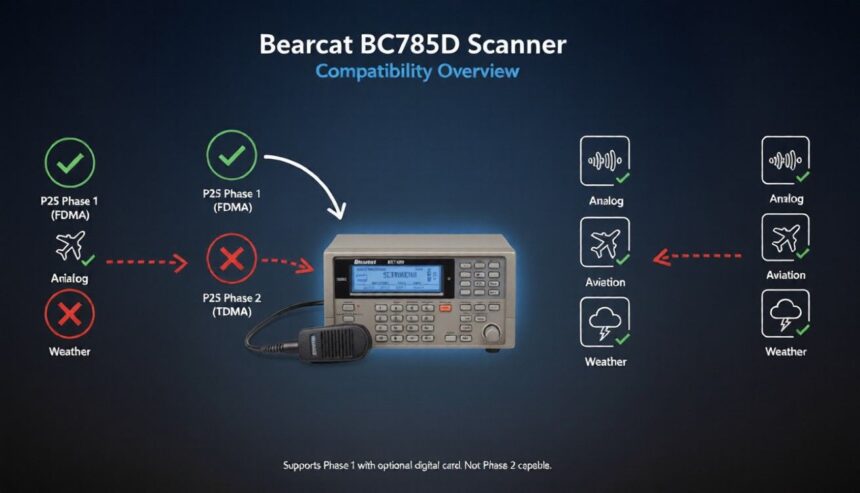
- If you have the optional digital card installed, Bearcat BCS785D can decode P25 Phase 1 (FDMA) transmissions. RadioReference Wiki+2Influencers Gone Wild+2
- However, Bearcat BCS785D does not support P25 Phase 2 (TDMA) decoding. Influencers Gone Wild+2Influencers Gone Wild+2
In other words: the BCS785D is not Phase 2 capable, even though it is “digital capable” in the sense of supporting Phase 1 with the proper hardware.
This limitation matters because many modern radio systems have either moved to — or are gradually migrating toward — Phase 2 for better channel efficiency and capacity. If a system uses TDMA/Phase 2, a BCS785D will likely fail to decode transmissions properly. Wikipedia+2Scanner Master Blog+2
Why Many Users Are Confused — “Digital Capable” Doesn’t Mean “Phase 2”
The confusion stems largely from product descriptions and expectations built around the word “digital capable.” When someone sees that a scanner supports digital audio, it’s easy to assume it handles all digital formats — but that’s not always true. With the BCS785D, “digital capable” specifically refers to its ability to handle certain P25 digital signals (Phase 1) when equipped with the optional module. RadioReference Wiki+2Influencers Gone Wild+2
Additionally, some radio systems operate in transitional modes or mixed systems. As explained by experts, even when agencies announce Phase 2 implementations, parts of the infrastructure (or radios) might still operate under Phase 1 for a while. This means a Phase 1-only scanner may still receive some traffic — giving users hope but also leading to inconsistent results. Scanner Master Blog+2Scanner Master Blog+2
Because of these mixed factors, many owners of BCS785D scanners wonder why they sometimes hear traffic clearly, and at other times get nothing or garbled audio. Often the answer lies in whether the system is using Phase 1 or Phase 2.
When the BCS785D Still Makes Sense — Analog and Legacy Systems
Although the BCS785D misses Phase 2 support, it does not mean the scanner is worthless. Far from it — it remains a capable tool in many contexts, especially where analog communications or older digital systems still operate.
Here are a few scenarios where using BCS785D makes sense:
- Monitoring aviation, marine, amateur radio, or weather bands that rely on analog transmissions. Many such channels remain analog worldwide.
- Tracking older trunked systems (Motorola Type I/II, EDACS, etc.) that haven’t moved to digital, or regions where agencies stick with analog for cost or regulatory reasons.
- Amateur radio hobbyists or collectors who appreciate the broad frequency coverage and trunk-tracking flexibility of the BCS785D.
Because of its versatility in analog and its optional Phase 1 digital capability, BCS785D still serves a niche when Phase 2 adoption is limited or non-existent in a listener’s region.
How to Check Whether Your Local System Uses Phase 1 or Phase 2
Before deciding whether the BCS785D is still useful in your area, it helps to confirm what type of radio system your local agencies operate. Many regions publish system details publicly, and this information tells you whether a Phase 1-only scanner will work or if upgrading is necessary. Agencies that rely heavily on public safety, medical services, or emergency response typically transition to Phase 2, but some still maintain mixed or Phase 1-compatible networks.
Most listeners use online frequency databases or local radio hobby groups to verify system types. These sources show whether channels use FDMA (Phase 1), TDMA (Phase 2), or a combination of both. If you see a system listed as “P25 Phase II,” it means the majority of its talkgroups likely require TDMA support, which the BCS785D cannot decode. However, if the system lists Phase 1 or shows analog trunking formats, your scanner can still function effectively.
Practical Signs Your System Uses Phase 2 Instead of Phase 1
You can often identify whether a system uses Phase 2 by how your scanner behaves during active transmissions. When using a Phase 1-only device like the BCS785D, a Phase 2 system often results in the scanner stopping on a talkgroup but failing to produce clear audio. Some listeners describe this as bursts of digital noise, broken speech, or complete silence even when the scanner locks onto the channel.
Another sign is inconsistent reception. Mixed systems sometimes alternate between Phase 1 and Phase 2 depending on which radios or talkgroups are active at the moment. In these cases, your BCS785D might occasionally produce clear audio during Phase 1 activity and then suddenly lose intelligibility once the system switches over to TDMA. This pattern explains why some users mistakenly believe their scanner is “partially Phase 2 compatible,” when in reality, the system itself is changing modes.
When It Makes Sense to Keep Using the BCS785D
Even though the BCS785D does not support Phase 2, it remains a practical tool for many listeners who focus on analog monitoring or older digital systems. In regions where public safety communications have not fully upgraded, the scanner still performs reliably and offers stable tracking on long-standing trunking formats.
Hobbyists who monitor aviation, maritime channels, amateur radio repeaters, or weather alerts will find that the BCS785D handles these frequencies well. These services operate outside the P25 Phase 1/Phase 2 framework entirely, which means the scanner’s limitations do not impact its functionality in those areas. For many users, the BCS785D serves as a capable secondary radio even after upgrading to a more modern primary device.
What to Consider If You Need Phase 2 Compatibility
If you live in an area where public safety and government systems rely on TDMA channels, upgrading to a Phase 2-capable scanner becomes necessary. The shift toward Phase 2 has accelerated in many regions due to the need for better channel efficiency and expanded communication capacity. Choosing a device designed for current digital standards ensures your monitoring setup remains usable for years.
When selecting a new scanner, consider several factors: sensitivity, trunking performance, ease of programming, firmware updates, and long-term manufacturer support. Modern scanners often include improved decoding algorithms, stronger filtering options, and better audio clarity, making them more reliable on busy digital systems. These improvements directly impact how consistently you can follow active transmissions.
Recommended Upgrades if You Need Phase 2 Support
If you decide the BCS785D no longer fits your listening needs, several devices on the market provide strong Phase 2 support. These models also offer better handling of modern trunked systems and advanced digital formats. Depending on your budget and monitoring style, you can choose between handheld units or full-sized base/mobile scanners.
Below is a column-style comparison of reliable Phase 2-capable scanners:
| Model | Type | Supports Phase 2? | Notable Strength |
| Uniden BCD436HP | Handheld | Yes | Portable design with broad database coverage. |
| Uniden BCD536HP | Base/Mobile | Yes | Excellent indoor reception and Wi-Fi features. |
| Whistler TRX-2 | Base/Mobile | Yes | Strong support for multiple digital formats. |
| Uniden SDS100 | Handheld | Yes | Superior performance on complex simulcast systems. |
| Uniden SDS200 | Base/Mobile | Yes | Enhanced reception, clear audio, and advanced decoding. |
These scanners offer full support for P25 Phase 2 TDMA, along with improved reliability on systems where older models like the BCS785D struggle. Choosing one of these ensures your monitoring setup can follow modern communication standards without interruption.
Conclusion: Understanding the BCS785D’s Role in Today’s Monitoring Environment
The Bearcat BCS785D supports P25 Phase 1 when equipped with the optional digital card, but it does not support Phase 2. While this limits its usefulness in areas that have migrated to TDMA systems, the scanner still performs well on analog channels, legacy trunking formats, and regions that continue to operate under Phase 1. For some users, the BCS785D remains a dependable device; for others, upgrading to a Phase 2-capable model ensures access to the full range of modern public safety communications.
For more quality, informative content, visit writewhiz