


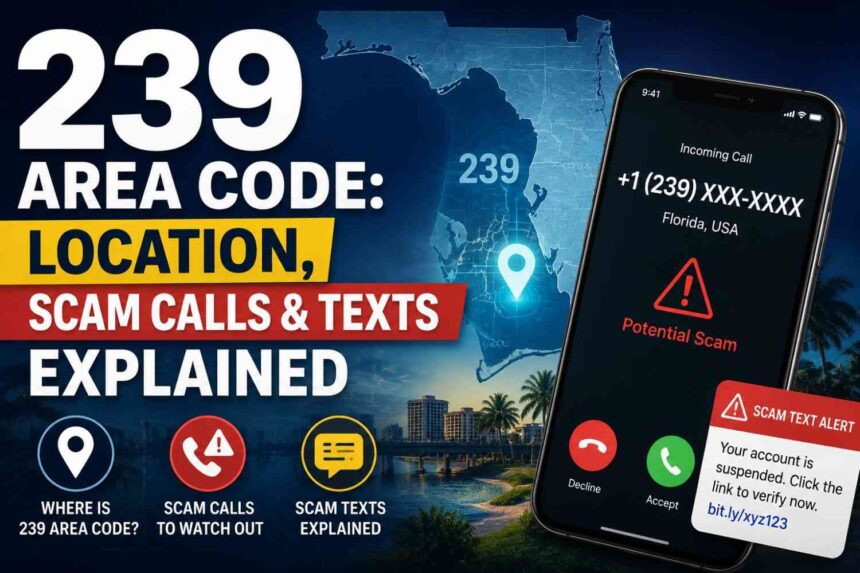
You just got a call or text from a 239 area code number, and something felt off. Here’s the reassurance you came for: the 239 area code is a real, legitimate code covering Southwest Florida, so the code itself is not a scam – but scammers do fake (spoof) 239 numbers heavily to look local.
By the end of this guide, you’ll know whether to worry, how to spot a 239 scam call or text, and the exact steps to block and report it.
One quick note before we start. This is general safety information, not legal or financial advice. If a call or text claims to be urgent, verify it directly with the real company or agency using a number you look up yourself.
Where Is the 239 Area Code?
The 239 area code serves Southwest Florida along the Gulf Coast, including Fort Myers, Cape Coral, Naples, Bonita Springs, and Marco Island. It covers Lee and Collier counties plus nearby areas, and it sits in the Eastern Time Zone.
The code has a clear history. It was created on March 1, 2003, as a split from area code 941, which originally covered a larger portion of southwestern Florida. The split happened because of fast population growth, and today 239 works as a standalone code that needs 10-digit dialing for local calls.
That growth is also why scammers love the region. Area code 239 covers southwestern Florida, including cities like Fort Myers, Naples, Cape Coral, and Marco Island, and was established as a split from area code 941 to support population growth; known for its beaches and seasonal residents, it is one of the most desirable retirement and vacation destinations in the country, with sustained development in healthcare, real estate, and tourism. A mix of retirees, tourists, and busy medical offices makes for a rich target.
Read Also: 352 area code – a full guide to another Florida code and its scam patterns.
Here are the key facts at a glance.
| Detail | Information |
|---|---|
| Region | Southwest Florida |
| Major cities | Fort Myers, Cape Coral, Naples |
| Counties | Lee, Collier |
| Time zone | Eastern |
| In service since | 2003 |
| Split from | Area code 941 |
| Dialing | 10-digit required |
Is the 239 Area Code a Scam?
No, the 239 area code is not a scam. It’s a legitimate area code used by millions of real Florida residents and businesses, but scammers often fake (spoof) 239 numbers to look local.
A call showing a 239 number could be a genuine neighbor, a local business, or your doctor’s office calling to confirm an appointment. The code alone can’t tell you whether a call is safe.
Picture a Fort Myers retiree who sees a 239 number and answers, expecting a neighbor. Instead, it’s a recorded robocall about a “car warranty.” The number on screen was fabricated – the caller could be anywhere in the world.
Still, 239 draws a heavy volume of complaints. According to ScamVerify’s analysis of federal data, the FTC has logged 63,605 complaints from 239 numbers, and the FCC independently recorded another 1,455. That’s why treating any unknown 239 call with caution is smart.
Why So Many Scam Calls Come From 239 Numbers
Neighbor spoofing is the main reason. Scammers fake a caller ID with a 239 prefix because people are far more likely to answer a call that looks local or matches their own area code.
The data backs this up. That same ScamVerify report found that 58.8% of 239 scam victims are Florida residents and 31% have a 239 number themselves – a textbook neighbor spoofing pattern, because people are far more likely to answer a call that looks like it’s coming from their own neighborhood.
Here’s what spoofing means for you in practice. The 239 number on your screen was almost certainly spoofed, the actual caller could be anywhere, and this is why blocking individual numbers has limited value – scammers generate thousands of spoofed numbers and discard them after a few calls.
So the same auto-warranty robocaller might reach you from five different 239 numbers in a single week. Calling back or blocking one number rarely stops the flood.
Common 239 Scam Calls to Watch For
These are the live-voice and robocall tactics tied to 239. (Scam texts run a different playbook, covered next.)
Government imposter calls are among the nastiest. Robocallers claim to be from the Social Security Administration or DEA and threaten a warrant for your arrest unless you verify your Social Security number – but real federal investigators do not call ahead to warn you about a warrant. They show up.
Utility threats work by panic. One reader reported a fake FPL call warning that service would be cut off in 30 minutes unless they paid immediately, demanding gift cards; they hung up – total scam. No real utility takes gift cards.
Tech-support “refund” calls target your bank. Robocalls claim a subscription like Webroot or McAfee will auto-renew for $200 or $299 and pressure you to call back for a refund, then steal your banking information during the fake refund – while real companies list charges in your account and don’t demand callbacks.
The table below sums up the five you’ll hear most.
| Scam Type | What They Claim | The Red Flag |
|---|---|---|
| Government imposter | SSA/DEA warrant; “verify your SSN” | Real agencies don’t call to warn of a warrant |
| Utility shut-off | Power off in 30 minutes; pay now | No utility demands gift cards |
| Auto warranty | “Your coverage is expiring” | Recorded voice, many rotating numbers |
| Tech-support refund | $199-$299 auto-renewal refund | Real charges appear in your account |
| Real estate cash offer | “Cash for your house” | Details pulled from public property records |
That last one is common in a hot market. Real estate investors call repeatedly from different numbers knowing your name and address, promising quick cash for your property – and they get your details because property information is public record.
Calls and Text Messages From the 239 Area Code: Spotting Scam Texts
Text messages from a 239 number are often scams (smishing) when they push urgency, contain links, promise money, or come from an unknown sender. Legitimate texts rarely do all four at once.
Text scams differ from call scams in style. Robotexts blast the same link to thousands of numbers at once, while a live scam text starts a slow conversation to build trust before the ask.
The patterns to know:
- The “wrong number” opener – A vague “hi, is this you?” text that eases into friendly chat, then pivots to a fake crypto or gift-card pitch.
- Prize or package bait – A “you have a refund/package/prize” message with a shortened link.
- Fake government check – A benefit or “check” message with a deadline and a shady link, like the “overdue” stimulus-style texts reported from 239 numbers.
Say you get a random 239 text that seems meant for someone else. You reply to be polite, the sender is warm and chatty, and a few days later they’re nudging you toward a “great investment.” That’s the trap.
Watch for these universal red flags in any 239 text:
- Unknown sender
- Urgency or a countdown deadline
- Shortened or odd-looking links
- Requests for personal or payment info
- Offers that seem too good to be true
How to Block and Report 239 Scam Calls and Texts
The fastest fix is to not engage – don’t answer, reply, or click. Then block the number on your phone and report the text to 7726 (SPAM) and the FTC.
On iPhone
- Open the message or recent call, then tap the sender’s number or the “i” info icon.
- Scroll down and tap Block this Caller.
- For texts, tap Report Junk below an unknown-sender message to send it to Apple and your carrier.
- Turn on Settings > Messages > Filter Unknown Senders to sort strangers into a separate list.
The built-in report tool helps, but it’s a supplement to federal reporting, not a replacement.
On Android
- Open the Messages or Phone app and press and hold the message or number.
- Tap **Block , then ** Report spam (Android can do both in one tap).
- In Messages settings, turn on **Spam protection ; in the Phone app, enable ** Caller ID & spam.
Reporting to the Authorities
Forward the text to 7726, which spells SPAM. 7726 is free and won’t count toward your plan usage, which is true for all major US providers and at least 700 other carriers internationally. The GSMA reserved this number for reporting spam texts and made it toll-free, and most major US carriers are members. Your carrier may reply asking for the sender’s number.
Then file reports with the right agencies:
- FTC at ReportFraud.ftc.gov for scams and fraud.
- FCC Consumer Complaint Center for unwanted robocalls and texts.
- FBI IC3 if you lost money or the fraud crossed state lines.
- TIGTA for IRS-impersonation calls.
Also add your number to the National Do Not Call Registry. It won’t stop outright scammers, but it makes illegal calls easier to spot. For an extra layer, third-party apps like Truecaller, Hiya, Nomorobo, or RoboKiller can filter calls and texts.
What To Do Next
Treat any unknown 239 call or text as guilty until proven innocent – let it go to voicemail, and never click a link or share personal details on the spot. Your single best move right now is to turn on your carrier’s free spam filtering and your phone’s built-in call protection, so most of these calls get flagged before they ever reach you.
For more quality, informative content that helps you make smarter, safer decisions, visit Writewhiz.
FAQ
Where is the 239 area code located?
The 239 area code is in Southwest Florida. It covers Fort Myers, Cape Coral, and Naples, along with Bonita Springs and Marco Island across Lee and Collier counties. The region runs on Eastern Time.
Is it safe to answer a call from a 239 number?
It can be, but letting unknown calls go to voicemail is the safest habit. The best move is to slow everything down and let unknown numbers go to voicemail. Legitimate callers usually leave a message, while scammers rarely do.
Why am I getting texts from a 239 area code?
Most unsolicited 239 texts are spam. Scammers either spoof a local 239 number through neighbor spoofing or blast random numbers hoping someone replies. If you don’t recognize the sender and the text pushes a link or urgency, treat it as spam.
Should I reply STOP to a 239 spam text?
No. Replying anything, even STOP, tells a scammer your number is active and can bring more messages. Just block the sender and report the text to 7726 instead.
What happens if I clicked a link in a 239 scam text?
Don’t panic, but act fast. Don’t enter any info on the page, run a security scan on your device, and change passwords for any account you may have exposed. Watch your bank and card statements, and if you shared sensitive details, start recovery at IdentityTheft.gov.
Does forwarding to 7726 actually stop the texts?
Not instantly. Each carrier uses the message contents to improve spam detection on its network. It helps carriers spot and block patterns over time, so pair it with blocking the sender for the best result.
Can I get a legitimate 239 number for my business?
Yes. Many phone service providers offer virtual 239 numbers to individuals and businesses regardless of physical location. A 239 number signals a local Southwest Florida presence, which customers there tend to trust.
How do I stop calls from a 239 area code for good?
No single fix stops spoofed calls completely. Combine blocking, your carrier’s spam filter, Do Not Call registration, and a filtering app. After you report the call, block the number; scammers may spoof new numbers, but blocking still helps cut down on repeat calls from the same source.
For more quality, informative content, visit writewhiz.