



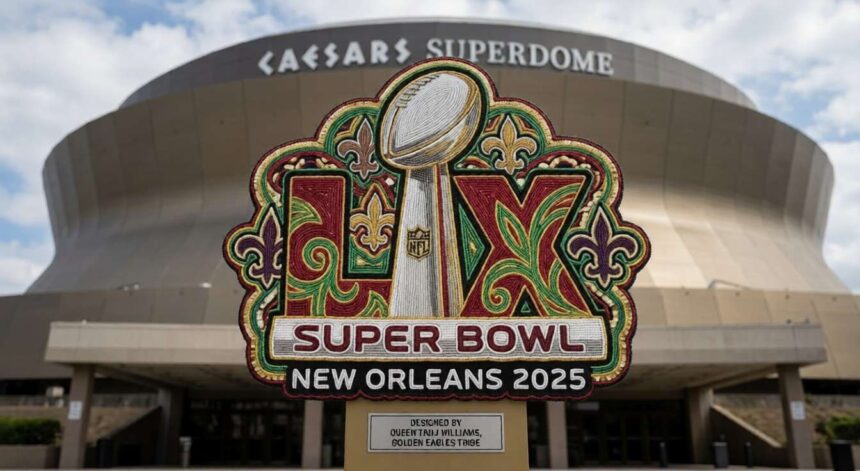
Super Bowl 2025 Logo: The Untold Story Behind the Most Meaningful Design in NFL History
The Super Bowl 2025 logo is unlike anything the NFL has ever put on a banner, a ticket stub, or a stadium wall. At first glance, it looks like an explosion of color — deep reds, vivid greens, shimmering golds — woven into an intricate beaded pattern that frames the Roman numerals LIX and the iconic Lombardi Trophy. But look a little closer, and you start to realize this isn’t just branding. It’s a piece of living cultural heritage, handcrafted by a 26-year-old New Orleans artist whose community has been telling stories through beadwork for generations. This is the story of how that logo came to be, what every element of it means, and why it represents a genuine turning point in how major sports leagues celebrate the cities that host them.
Why the Super Bowl LIX Logo Is Unlike Any That Came Before It
Every Super Bowl has a logo. Most of them follow a familiar formula — bold typography, the host city’s colors, maybe a nod to a local landmark. They’re professionally designed, perfectly polished, and largely forgettable. The Super Bowl LIX logo breaks that pattern entirely.
For the first time in the history of the NFL, the league went outside its usual design apparatus and commissioned a local artist to craft the official Super Bowl emblem from scratch — not digitally, but physically, by hand. The result is something that feels less like corporate branding and more like an artifact. And that distinction matters, because it shapes everything about how this logo looks and what it communicates to the world.
The logo was officially revealed on February 12, 2024, just one day after the Kansas City Chiefs won Super Bowl LVIII in Las Vegas. The timing was intentional — the NFL wanted to immediately shift the spotlight to New Orleans and begin building anticipation for the following year’s game at Caesars Superdome.
Meet Queen Tahj Williams: The Artist Who Made History
A Young Queen With Deep Roots
The woman behind the Super Bowl 2025 logo is Tahj “Queen Tahj” Williams, a New Orleans native and a queen of the Golden Eagles, one of the city’s celebrated Black Masking Indian tribes. At just 26 years old when the collaboration was announced, she became the first artist ever to partner with the NFL on the creation of a Super Bowl logo — and then, a short time later, also designed the official Super Bowl LIX theme art, making her the first to do both.
Williams grew up immersed in New Orleans’ rich second-line culture. She spent Sundays following brass bands through neighborhoods, watching Big Chiefs emerge from their blocks in spectacular feathered suits, and learning the intricate art of beadwork that defines Black Masking Indian tradition. This wasn’t a hobby or a side interest — it was the language of her community, passed down through generations, stitched one bead at a time.
She’s also a graduate of Tulane University’s School of Professional Advancement, where she studied information technology. Her background is a fascinating blend of traditional craft and modern education, and it shows in the precision and intentionality of her work.
Why the NFL Chose Her
When the NFL began planning for Super Bowl LIX in New Orleans, leadership made a conscious decision to move away from generic “Big Easy” imagery — the harlequin masks, the trumpets, the alligators — and reach for something more authentic and less expected. They found it in Williams.
Marissa Solis, the NFL’s Senior Vice President of Global Brand and Consumer Marketing, put it plainly: Queen Tahj’s deep connection to her community and her extraordinary talent made her the obvious choice for a project that was meant to honor the real New Orleans, not the tourist-brochure version of it.
Williams herself described the partnership as a dream come true, and spoke about how football has shaped her life since childhood — she was the only girl and the captain of her middle school football team. “This is definitely a moment that is going to live with me forever,” she said.
Decoding the Super Bowl 2025 Logo: What Every Element Means
The Beadwork Technique
The most immediately striking thing about the Super Bowl LIX logo is its texture. It doesn’t look like it was made on a screen. That’s because, in a very real sense, it wasn’t. Williams created the logo using the same hand-sewing and beadwork techniques she uses to build her tribe’s ceremonial Mardi Gras Indian suits — a process that can take an entire year of meticulous labor for a single garment.
The beads themselves aren’t decorative afterthoughts. In Black Masking Indian culture, each beaded patch tells a story. The patterns are deliberate, the colors carry meaning, and the craft demands both physical dedication and deep cultural knowledge. Williams brought all of that to the NFL’s biggest stage.
The Colors: Purple, Green, and Gold
The color palette of the Super Bowl 2025 logo draws directly from Mardi Gras tradition. Purple, green, and gold have represented the spirit of New Orleans’ most famous celebration since the late 1800s, with each color carrying its own symbolic weight — purple for justice, gold for power, and green for faith. Together, they immediately signal “New Orleans” to anyone who has ever attended or followed Mardi Gras, making the logo legible as a cultural statement even before you read a single word of explanation.
Williams also incorporated colors from her own tribe’s tradition — bright pinks, rich reds, eye-catching chartreuses — weaving her personal artistic identity into the broader cultural tapestry of the design.
The Fleur-de-Lis
Embedded within the logo’s intricate patterns is the fleur-de-lis, one of the most recognizable symbols in all of New Orleans. It appears on the helmets of the New Orleans Saints, it decorates the ironwork balconies of the French Quarter, and it has served as a symbol of the city’s French colonial heritage for centuries. Its inclusion in the Super Bowl LIX logo grounds the design firmly in place — this logo could only belong to New Orleans.
The Roman Numerals and the Lombardi Trophy
At the center of the design, framed by Williams’ beadwork, are the Roman numerals LIX and a rendering of the Lombardi Trophy. This follows the logo template the NFL established with Super Bowl LVI, where the Roman numerals became the canvas for host-city imagery rather than just a number. What makes LIX distinctive is that the numerals themselves are integrated into the beadwork, not simply placed on top of it. The trophy and the numerals feel like they grew out of the cultural design rather than being inserted into it — a subtle but powerful difference.
Where the Super Bowl LIX Logo Appeared
The Super Bowl 2025 logo wasn’t just a patch on a press release. It showed up across every major touchpoint of the event. It appeared on digital game tickets sent to tens of thousands of fans. It was featured on the cover of the official Super Bowl LIX program. Perhaps most visibly, it was displayed on the exterior of the Hyatt Regency New Orleans hotel, giving it a physical presence in the city’s skyline during Super Bowl week. It also served as the foundation for all official Super Bowl LIX merchandise and stadium branding at Caesars Superdome.
Williams also created a companion piece — the Super Bowl LIX theme art — which extended her visual language beyond the logo itself and appeared on additional official materials. Having one artist responsible for both the logo and the theme art gave the entire visual identity of Super Bowl LIX a cohesion that previous years’ branding hadn’t always achieved.
How the Super Bowl LIX Logo Fits Into the Broader History of Super Bowl Logos
The Modern Logo Era: Super Bowl LVI Onward
The NFL’s approach to Super Bowl logos has evolved significantly over the decades. For much of the game’s history, the logo was a fairly standardized design — clean, corporate, and interchangeable from year to year. Starting with Super Bowl LVI in Los Angeles, the league shifted to a new template where the Roman numerals became the focal point and the host city’s imagery was worked directly into the design. This made each logo feel more specific and more celebratory of its location.
Super Bowl LIX builds on that framework but takes it to a new level by introducing handcrafted artwork from a community artist rather than relying solely on a professional design agency.
A Quick Look at Recent Super Bowl Logos
| Super Bowl | Year | Host City | Key Design Element | Designed By |
|---|---|---|---|---|
| LVI | 2022 | Los Angeles, CA | SoFi Stadium arch, LA sunburst | NFL Design Team |
| LVII | 2023 | Glendale, AZ | Desert landscape, Arizona flora | NFL Design Team |
| LVIII | 2024 | Las Vegas, NV | Neon lights, casino-inspired patterns | NFL Design Team |
| LIX | 2025 | New Orleans, LA | Black Masking Indian beadwork, fleur-de-lis | Queen Tahj Williams (local artist) |
The contrast in that final row is significant. Super Bowl LIX is the first time the “Designed By” column names a community artist rather than an anonymous in-house team. That’s not a small footnote — it’s a shift in philosophy.
The Cultural Significance of the Super Bowl 2025 Logo
Understanding Black Masking Indian Tradition
To fully appreciate what Queen Tahj Williams brought to this logo, it helps to understand the tradition she represents. Black Masking Indians — sometimes called Mardi Gras Indians — are groups within New Orleans’ African American community who trace their cultural practices back to the historical connections between enslaved Africans and Indigenous Americans in Louisiana. For generations, these communities have masked together on Mardi Gras and St. Joseph’s Night, wearing spectacular, handmade suits adorned with feathers and thousands of individually sewn beads.
The suits themselves are considered sacred artistic expressions. A single suit can contain tens of thousands of beads, require over a year of work to complete, and tell a specific story through its imagery and iconography. The beading traditions passed down through tribes like the Golden Eagles represent an unbroken line of cultural creativity that stretches back more than a century.
Williams, as a queen of her tribe, is not just an artist — she’s a cultural steward. Bringing her work to the Super Bowl stage meant bringing a tradition that most of the 127.7 million people who watched Super Bowl LIX had probably never encountered before.
What It Means for Sports and Culture
The decision to partner with a local community artist on the Super Bowl’s official visual identity sets a precedent that the sports world will likely follow. It demonstrates that authenticity and cultural specificity aren’t obstacles to broad appeal — they’re assets. People connect more deeply with stories that are genuinely rooted somewhere, made by someone with real stakes in the tradition they’re representing.
Williams expressed this clearly when she talked about why the design mattered to her personally: when people think about New Orleans, she said, they think about the French Quarter. But the city is so much more than that — it’s the second line, the brass bands, the Baby Dolls, the Skull and Bone gang, the Black Masking Indians. She wanted all of that to shine through.
It did.
Super Bowl LIX Logo vs. Past Logos: A Design Perspective
From a purely design standpoint, the Super Bowl LIX logo stands apart in several ways. Where previous logos tended toward clean vector graphics and flat color fills, this one has visual depth and physical warmth — qualities that come directly from its handcrafted origins. The symmetry of traditional beadwork gives it a structured elegance, while the color intensity makes it immediately eye-catching even at small sizes, which matters enormously in a digital media environment where logos appear on everything from phone screens to billboard-sized stadium displays.
The logo also works unusually well in both color and reduced-color formats, which is a genuine design achievement when the palette is as rich and varied as Williams used. The underlying geometric logic of beadwork pattern-making — which is essentially a form of pixel art, executed in thread and glass — translates remarkably well to digital reproduction.
| Design Attribute | Typical NFL Logo | Super Bowl LIX Logo |
|---|---|---|
| Creation Method | Digital vector design | Hand-beaded, then digitized |
| Cultural Specificity | General host-city reference | Deep local cultural tradition |
| Artist Background | Professional design agency | Community cultural artist |
| Color Approach | 2–3 brand colors | Multi-color traditional palette |
| Texture & Depth | Flat graphic | Rich, layered visual texture |
| Historic Distinction | Standard practice | First of its kind |
Conclusion
The Super Bowl 2025 logo is, without question, one of the most meaningful pieces of visual design in the NFL’s 59-year championship history. It’s not meaningful because it’s the most technically sophisticated logo ever made, or because it spent the most money on production. It’s meaningful because it came from somewhere real. It came from a 26-year-old artist who grew up sleeping next to the outfit she planned to wear to the next second line, who learned beadwork not in a design school but in a tribal tradition, and who poured all of that into a piece that will be seen by hundreds of millions of people around the world.
Queen Tahj Williams didn’t just design a logo. She put a community on the biggest stage in American sports and said: this is who we are. And the NFL, to its credit, let her. That partnership — between institutional power and local artistry — is what makes the Super Bowl LIX logo something worth writing about long after the confetti has settled.
Frequently Asked Questions
What does the Super Bowl 2025 logo look like?
The Super Bowl 2025 logo features the Roman numerals LIX and the Lombardi Trophy rendered in intricate hand-beaded artwork inspired by New Orleans’ Black Masking Indian tradition. The design uses a vibrant palette that includes deep reds, greens, golds, and pinks, and incorporates the fleur-de-lis — a longtime symbol of New Orleans — woven throughout the beadwork pattern. The overall effect is visually rich and unlike any previous Super Bowl logo.
Who designed the Super Bowl LIX logo?
The logo was designed by Tahj “Queen Tahj” Williams, a 26-year-old New Orleans artist and queen of the Golden Eagles, a Black Masking Indian tribe. She became the first artist outside the NFL’s own design apparatus to create an official Super Bowl logo, and she also designed the Super Bowl LIX theme art, making her the first person to do both for a single Super Bowl.
When was the Super Bowl 2025 logo revealed?
The Super Bowl LIX logo was unveiled on February 12, 2024 — the day after the Kansas City Chiefs defeated the San Francisco 49ers in Super Bowl LVIII in Las Vegas. The NFL released it simultaneously with its announcement of the countdown to the New Orleans game.
What is Black Masking Indian culture and why does it matter to the logo?
Black Masking Indians, also known as Mardi Gras Indians, are groups within New Orleans’ African American community with cultural traditions rooted in the historical solidarity between enslaved Africans and Indigenous Americans in Louisiana. Each year on Mardi Gras, members of these tribes — including the Golden Eagles, Queen Tahj’s tribe — wear elaborately hand-beaded and feathered suits that can take over a year to create. The beadwork on the Super Bowl LIX logo is a direct expression of this tradition, making the logo not just a piece of NFL branding but a genuine artifact of a living cultural practice.
Is the Super Bowl 2025 logo available for free download?
The Super Bowl LIX logo is the intellectual property of the NFL and protected by copyright. While unofficial PNG versions circulate online on various free-download sites, using the official logo for commercial purposes without licensing is not permitted. For personal, non-commercial reference use, image search engines index several high-resolution versions of the logo.
For more quality, informative content, visit writewhiz