


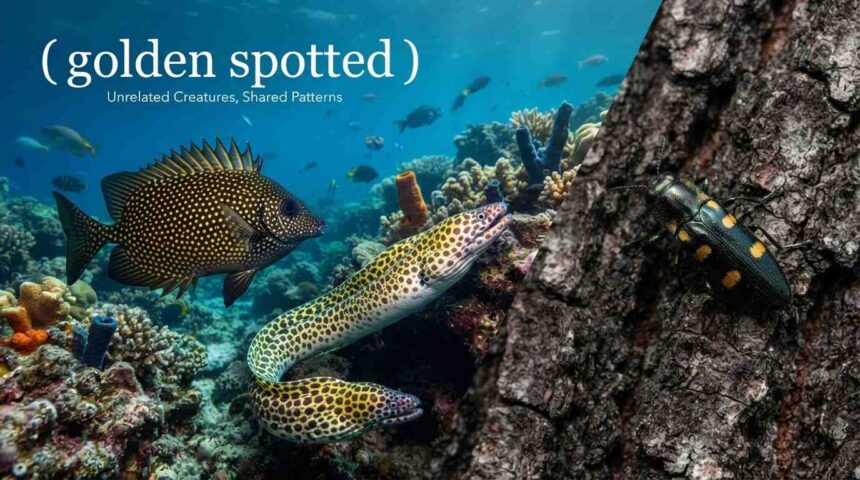
Golden spotted isn’t one animal. It’s a nickname shared by several unrelated creatures with brown or dusky bodies dotted with gold, including a few saltwater fish and one tree-killing beetle. So if you searched the term and landed on a confusing mix of aquarium pages and bug warnings, you’re in the right place.
You might be after a reef fish for your tank, a food fish at the market, a mudskipper that walks on land, or a pest chewing through oak trees. This guide sorts them out fast, using scientific names so nothing gets mixed up.
Brand fit note
This topic sits outside our usual finance, tech, and real estate coverage, but it fits our general-interest and lifestyle publishing.
We’ve kept it purely educational, with a couple of related reads flagged only where the subject genuinely branches into pets or seafood.
What Does “Golden Spotted” Actually Mean?
“Golden spotted” is a plain description, not a single species. Several unrelated animals earned the label independently because they all share brownish bodies covered in gold or orange spots. You’ll also see it spelled “gold spotted” or “goldspotted.”
That’s why searches get tangled. None of these creatures are close relatives, yet they answer to the same casual name.
Picture someone who spots “golden spotted” on an aquarium store tab and assumes it’s the same creature a friend warned them about killing oak trees. Those are two completely different animals: a reef fish and a beetle.
The reliable fix is the Latin (scientific) name. This guide leans on those to keep every species straight.
The Golden Spotted Fish (And How to Tell Them Apart)
Most “golden spotted” searches point to marine fish, so let’s sort the main ones by habitat, size, and care level. Two of them carry venom, so getting the ID right has real safety stakes.
The gold spotted rabbitfish (Siganus punctatus) is a peaceful reef fish. Also known as the Gold Spotted Spinefoot, it originates from the reefs of the Coral Sea, with a brown body covered in golden spots that even work into the eye to aid camouflage. Hobbyists should know it needs a big tank and careful handling. According to LiveAquaria, it requires a 180-gallon or larger aquarium, and its venomous dorsal spines mean care must be taken when handling to avoid being stung. It’s an herbivore and reef-safe with caution.
New keepers sometimes confuse it with the orange-spotted spinefoot (Siganus guttatus). One retailer notes the true gold spotted fish is not to be mistaken for the more common Orange Spotted Rabbitfish, which has a larger spotted pattern and a duller appearance.
The golden spotted eel (Gymnothorax moringa), better known as the spotted moray, is an expert-only fish. Spotted morays average 60 to 75 cm with a maximum near 1.2 m, and have a long snake-like body, white or yellowish with dark spots. It lives across the Atlantic and Caribbean. This one is carnivorous and secretive, and morays in the aquarium trade are predators that usually cannot be kept in groups. Beginners tempted by its looks should think twice: it will eat smaller tankmates.
The gold-spotted mudskipper (Periophthalmus chrysospilos) is the odd one out, an amphibious mangrove fish that walks on land. Mudskippers are classified in the fish family Gobiidae, walk and hop on land, and use their pectoral fins for paddling and walking on the ground. It lives across Southeast Asian mudflats. Research on Mekong Delta populations warns that the Gold-spotted mudskipper faces extirpation risks from indiscriminate harvesting for the growing aquarium and food-fish trade.
Two more show up mainly at the seafood counter. The goldspotted rockcod (Epinephelus coioides) goes by many names. The orange-spotted grouper, also called estuary cod or goldspotted rockcod, has an Indo-Pacific distribution and is found in marine and brackish waters. Young fish are usually found in estuaries and silty areas, moving offshore as adults. The golden spotted tilefish is largely a culinary listing, sold whole at market.
Here’s how the five compare:
| Common Name | Scientific Name | Where It Lives | Max Size | Notable Trait |
|---|---|---|---|---|
| Gold spotted rabbitfish | Siganus punctatus | Coral Sea reefs | ~12 in | Venomous dorsal spines |
| Golden spotted (spotted moray) eel | Gymnothorax moringa | Atlantic/Caribbean reefs | ~4 ft | Expert-only carnivore |
| Gold-spotted mudskipper | Periophthalmus chrysospilos | SE Asian mangroves | ~4 in | Walks on land |
| Goldspotted rockcod | Epinephelus coioides | Indo-Pacific estuaries/reefs | ~4 ft | Edible food fish |
| Golden spotted tilefish | (market name) | Offshore waters | varies | Sold at market |
See also: Calamariere
The Golden Spotted That Is Not a Fish: The Oak Borer Beetle
If your search was about trees, plants, or a pest, “golden spotted” almost certainly means the goldspotted oak borer, a beetle. Its Latin name, Agrilus auroguttatus, literally points to gold spots, which is where the common name comes from.
This is a flatheaded jewel beetle. Adults are about 0.4 inch long with bullet-shaped bodies, black with an iridescent green sheen and six distinct gold spots on their back.
The story is a cautionary one. Per UC IPM, the beetle was introduced to San Diego County in the late 1990s or early 2000s and was likely brought in on oak firewood from its native range in southeastern Arizona or northern Mexico. It’s now a serious threat to California oaks. The US Forest Service and UC IPM both track it closely.
The damage is slow but deadly. Larvae feed beneath the bark near the tissues that conduct nutrients and water, and trees die after several years of injury from multiple generations of the beetle. It hits coast live oak and California black oak hardest.
The common homeowner mistake? Hauling firewood between regions and spreading the pest without knowing. The standard guidance is simple: don’t move firewood, and buy it where you’re going to burn it.
How to Correctly Identify Any “Golden Spotted” Species
Start with where you saw it. A saltwater tank, a mangrove shore, a seafood counter, and an oak tree each point to a different animal.
Body shape is the fastest sorter:
- Long and eel-like – the spotted moray eel.
- Disk-finned and land-walking – the gold-spotted mudskipper.
- Deep-bodied reef fish – the rabbitfish or rockcod.
- Small metallic beetle – the goldspotted oak borer.
Confirm with the scientific name before you buy a fish or treat a tree. Lean on trusted sources: Wikipedia for taxonomy, LiveAquaria for aquarium care, and UC IPM for the beetle.
Consider a reader who assumed all “gold spotted” fish were reef-safe and peaceful. They later learned the eel is a carnivore that eats tankmates and that the rabbitfish carries venomous spines. Names look alike; behavior doesn’t.
See also: PetQRDAS.com
What To Do Next
Match your “golden spotted” to its scientific name before you act, because the label alone tells you almost nothing about whether the animal stings, bites, or belongs in your tank. If it’s a fish, check a care sheet on LiveAquaria and confirm the Latin name; if it’s about oak trees, report suspected sightings to your local UC Cooperative Extension office and stop moving firewood today.
FAQ
Is “golden spotted” one animal or many?
Many. It’s a shared common name for several unrelated species plus one beetle. The fish include the gold spotted rabbitfish, the spotted moray eel, the gold-spotted mudskipper, and the goldspotted rockcod. The odd one out is the goldspotted oak borer, an insect.
Is the gold spotted rabbitfish venomous?
Yes. Its venomous dorsal spines can be raised when disturbed, so care must be taken when handling this fish to avoid being stung. The sting is painful but the fish itself is peaceful with most tankmates.
What is the golden spotted eel and is it hard to keep?
It’s the spotted moray, Gymnothorax moringa, a long Atlantic reef eel. It’s expert-only. Moray eels in the trade are predators that usually can’t be kept in groups, and tankmates should be chosen carefully since an eel may prey on smaller ones.
What is the goldspotted oak borer?
It’s an invasive beetle killing California oaks. According to UC IPM, Agrilus auroguttatus was introduced to San Diego County and has caused extensive injury and mortality to oaks since at least 2000. The US Forest Service tracks it too.
Can you eat golden spotted fish?
Yes, some are food fish. The goldspotted rockcod (Epinephelus coioides) is common and expensive in markets of the region, sold fresh and kept alive at restaurants in Asian countries. The golden spotted tilefish is also sold at market.
Where do golden spotted species live?
The fish live in Indo-Pacific reefs and mangroves and the Atlantic, depending on the species. The beetle is different: it is native to southeastern Arizona, where it is found in oak woodlands, and has since spread into California.
How do I stop spreading the goldspotted oak borer?
Don’t move firewood. Buy firewood where you’re going to burn it, and if you remove an infested tree, keep the cut wood away from healthy oaks and tarp or grind it to kill larvae. Report suspected sightings to local experts.
For more quality, informative content, visit Write Whiz.