



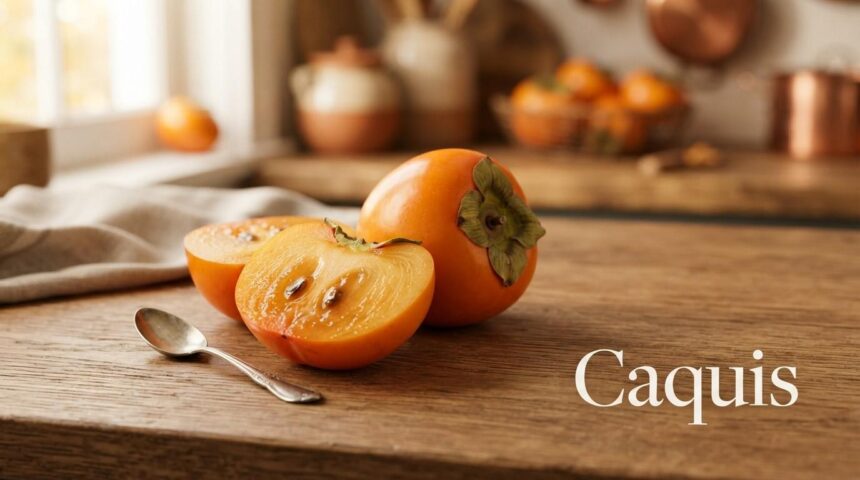
Caquis fruit (singular caqui) is the Spanish name for the persimmon, also called kaki – the sweet, orange, autumn fruit of the Diospyros kaki tree that looks a lot like a tomato. You probably spotted it at a market and wondered whether to eat it firm or soft, and how.
This guide answers that in plain terms: what caquis are, how to tell the types apart, how to eat and ripen them, and what’s inside them nutritionally.
One quick note before we start. This is general food information, not personalized medical or dietary advice. If you have diabetes, kidney concerns, or digestive issues, check with your doctor first.
What Is Caquis Fruit?
Caquis fruit is the persimmon – the edible fruit of the Diospyros kaki tree, native to Asia and now widely grown in Spain, Italy, Japan, and China. It’s round or slightly squat, orange to red-orange, and honey-sweet when ripe.
The names can feel like a maze, but they point to one species. Caqui and caquis are Spanish, kaki is the botanical and Japanese term, and persimmon is the English word. The branded names Sharon fruit and Persimon describe the same fruit given different varieties or treatments.
The taste is mild and very sweet, a little like a blend of peach and mango. Texture is the big variable: some caquis stay crisp like an apple, while others turn to soft, spoonable jelly.
The fruit traces back a long way. The persimmon (Diospyros kaki L.) is a fruit native to China, nowadays cultivated in warm regions all around the world.
Read Also: Navigator Pear guide
Caqui vs Persimmon vs Sharon Fruit
They are the same species, Diospyros kaki, but they differ in variety, ripeness, and how they’re treated after harvest. That’s why one caqui puckers your mouth, and another eats like a sweet apple.
Traditional caqui is the soft, jelly-like fruit you scoop with a spoon once fully ripe. Persimon is a registered Spanish brand for theRojo Brillante variety, given a controlled treatment (often carbon dioxide) that removes astringency while keeping the flesh firm. Persimmons are produced under Protected Designation of Origin Kaki Ribera del Xúquer, and are known around the world by the trademarked name Persimon.
Sharon fruit is a non-astringent type, originally from Israel, also sold firm and ready to eat.
| Type | Texture when eaten | Astringency | How to eat | Best for |
|---|---|---|---|---|
| Traditional caqui | Soft, jelly-like | High until fully ripe | Spoon it out when very soft | Desserts, purées |
| Persimon (Rojo Brillante) | Firm, crisp | Removed by treatment | Slice like an apple, skin on | Fresh eating, salads |
| Sharon fruit | Firm to slightly soft | Low | Eat firm, skin edible | Snacking, slicing |
Astringent vs Non-Astringent
Get this one thing right and you’ll never have a bad caqui. Never eat a firm astringent persimmon. Its tannins cause a dry, mouth-puckering feeling, so astringent types (like Hachiya) must be fully soft and ripe, while non-astringent types (like Fuyu, Rojo Brillante) can be eaten firm.
Picture a first-timer biting into a firm, pretty orange kaki and getting a chalky, sawdust mouthfeel. That happens because these tannins bind to proteins in your saliva and mucous membranes, creating a sensation that goes way beyond bitter or sour – a dry, chalky, felt-like coating. As the fruit softens, those tannins bind together and the astringency disappears.
Shape is your shortcut at the store. If you can’t remember which is which, look at the bottom – flat means Fuyu (firm eating), pointed means Hachiya (must be soft).
There is a rare digestive risk worth knowing, framed calmly. Eating very large amounts of unripe astringent fruit can, in unusual cases, form a hard mass in the stomach. As Medical News Today notes, ingesting massive amounts of persimmons can cause bezoars to form, and a bezoar is a hard mass that can lead to gastric obstruction. Normal eating of ripe fruit isn’t the concern here.
How to Eat and Ripen Caquis Fruit
Eat firm non-astringent caquis like an apple – wash, slice, and enjoy the edible skin. Eat soft astringent ones with a spoon once they turn jelly-soft. The Spanish Rojo Brillante makes this easy. You can eat the fruit like an apple with the skin on, or peel it and slice off the top.
If your caqui is rock-hard and astringent, ripen it at home using ethylene gas, a natural ripening hormone. Here’s the method the University of Florida IFAS Extension recommends:
- Put 3 to 4 persimmons in a clean paper bag with one apple or banana.
- Fold the bag closed and keep it at warm room temperature.
- Check them daily so they don’t over-ripen; they should soften in 2 to 3 days, depending on how hard they were.
Serving ideas are simple. Slice firm caquis into salads or onto a cheese board, spoon soft ones over yogurt, blend into smoothies, or dry them for a chewy snack.
Two practical warnings. Ripe caqui juice stains clothing, so eat soft ones over a plate. And avoid eating very astringent, underripe fruit on an empty stomach.
Read Also: Le Creuset 11.19 Blau Schale and Pirog v Multivarke recipe ideas
Health Benefits and Nutrition
Caquis are a nutrient-dense, low-fat fruit rich in fiber, vitamin C, vitamin A (beta-carotene), potassium, and antioxidants. In plain terms, the fiber supports digestion, vitamin C helps immune function, potassium supports heart and blood pressure health, and the antioxidants and beta-carotene are good for skin and eyes.
The fiber content stands out. One Japanese persimmon contains around 6 grams of fiber, and consuming enough fiber can help maintain healthy digestion and prevent constipation. Medical News Today also points to the antioxidants: especially carotenoids and flavonoids, which fight free radicals and may lower the risk of issues such as cardiovascular disease, high blood pressure, and high cholesterol.
Caquis are naturally high in sugar, though. If you’re watching blood sugar, keep portions modest and enjoy them as part of a balanced meal.
Here are approximate values per 100 grams, drawn from Nutrition and You:
| Nutrient | Approximate amount (per 100g) | Why it matters |
|---|---|---|
| Calories | ~70 kcal | Moderate energy, very low fat |
| Fiber | 3.6 g | Digestion and fullness |
| Vitamin C | 7.5 mg | Immune support |
| Vitamin A / beta-carotene | Present (carotenoids) | Skin and eye health |
| Potassium | 161 mg | Blood pressure and heart |
A ripe caqui also makes a smart swap. Instead of a sugary biscuit after dinner, a spoonful of soft, honey-sweet caqui gives you a whole-food dessert with fiber built in.
Read Also: Pravi Celer
Where Caquis Come From and When They’re in Season {#where-caquis-come-from}
Persimmons originated in China and spread to Japan, Korea, and later Europe. Spain – especially Valencia’s Ribera del Xúquer – is now a leading producer and exporter, with Rojo Brillante protected under PDO Kaki Ribera del Xúquer. Spain is the number one exporter of persimmons in the world, offering a uniquely sweet fruit with firm flesh and virtually no astringency.
That protected status is fairly recent. The Kaki Ribera del Xúquer designation is a quality mark created in 1998 and recognised as a Protected Designation of Origin by the European Commission in 2001.
Season is short and firmly autumn to winter. Persimmon season in Spain is fleeting, typically lasting from mid-October until January. In the Northern Hemisphere, that’s your window.
The fruit carries real cultural weight, too. Persimmons are the national fruit of Japan, a symbol of autumn there, and Italians enjoy their “cachi” right through the colder months.
Read Also: Tribupneu
The Bottom Line
Buy caquis with confidence once you read two things: the shape and the firmness. Flat and firm (Fuyu, Persimon, Sharon) means slice and eat now; pointed and astringent (Hachiya, traditional caqui) means wait until it’s jelly-soft.
Your next move is easy. Grab one this week, do the paper-bag trick if it’s hard, and taste the difference a ripe caqui makes.
FAQ
Is caqui the same as persimmon?
Yes. Caqui (or kaki) is the Spanish and botanical name, and persimmon is the English word. They refer to the same species, Diospyros kaki, so any recipe calling for persimmon works with caquis.
Can you eat caquis fruit skin?
Yes, for firm, non-astringent types. Just wash the fruit and slice it – the smooth skin is edible, much like an apple’s. With very soft astringent caquis, most people scoop the flesh with a spoon instead.
Why does persimmon make my mouth feel dry or chalky?
That’s tannins in an unripe, astringent fruit. The tannins bind to proteins in your saliva, creating a dry, chalky coating. Eat astringent types only when fully soft, or choose non-astringent varieties like Fuyu or Rojo Brillante.
How do you ripen a caqui quickly?
Place it in a paper bag with an apple or banana at room temperature. Ethylene is a natural plant hormone that promotes ripening, and the enclosed bag retains the gas. Check daily; it usually softens in 2 to 3 days.
Are caquis good for you?
Yes, in moderation. They’re low in fat and offer fiber, vitamin C, potassium, and antioxidants. Because they’re naturally high in sugar, people managing blood sugar should watch portion sizes.
What is the difference between caqui and Persimon?
Caqui is the general fruit. Persimon is a branded, de-astringed Rojo Brillante persimmon that’s treated so it stays firm and sweet without any puckering, sold under a protected designation of origin from Valencia.
When are caquis in season?
Autumn to early winter. In the Northern Hemisphere, that’s typically from mid-October until January, which is why caquis show up as a cool-weather market fruit.
Can I eat caquis fruit every day?
Generally yes, as part of a balanced diet. Keep an eye on portions if you’re watching sugar, and remember that people should be careful not to eat too many persimmons in one sitting, as excessive amounts may cause adverse effects.
For more quality, informative content, visit Write Whiz.