



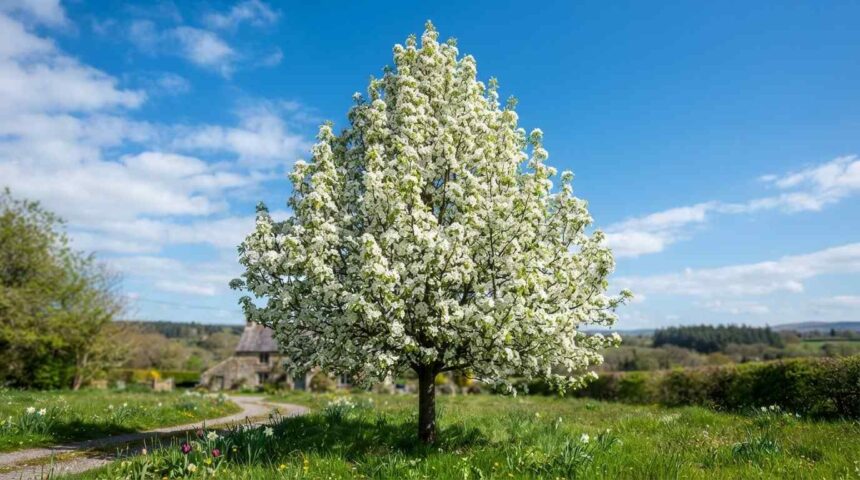
The navigator pear is a cold-hardy ornamental tree grown for its white spring flowers, glossy foliage, and bright fall color – not for edible fruit. If you saw one at a garden centre and wondered whether to plant it (and whether it’s the same troublemaker as the invasive Bradford pear), this guide gives you a clear verdict plus practical planting and buying advice.
One thing to settle up front: this is an ornamental, not an orchard tree. We’ll cover its real size, how to care for it, where it fits, and how it relates to the Callery pear controversy.
A quick, honest note: plant availability, mature size, and any ornamental-pear rules vary by region. Always confirm locally before you buy
What Is a Navigator Pear Tree?
The navigator pear is a deciduous ornamental pear cultivar,Pyrus x ‘DurPSN303’, valued for its tidy form and seasonal color rather than its fruit. It’s grown as a flowering accent tree, not a source of eating pears.
It’s a cold-hardy introduction bred for tough northern climates. The tree is a Prairie Shade Nursery introduction, and most listings describe it the same way. It’s an extremely hardy, dense, pyramidal ornamental pear with bright white blooms in early to mid-spring, dark green glossy foliage that turns orange-yellow in fall, and an excellent form for smaller landscape sites.
A common mistake is assuming it’s a European dessert pear (Pyrus communis) for a home orchard. It isn’t.
Picture a shopper who spots “Navigator pear” on a nursery tag and pictures a summer harvest of juicy pears. In reality, this tree rarely fruits, and any fruit is small and ornamental. Buyers also see it labeled navigator ornamental pear or by its botanical name, so don’t let the naming confuse you.
Navigator Pear Tree Characteristics and Four-Season Appeal
Its biggest selling point is a tidy, upright-to-pyramidal shape that gives you interest in all four seasons. Prized for its pyramidal form, it dazzles in early to mid-spring with bright white blossoms, followed by glossy heart-shaped green leaves, then a fall transition to yellow-red hues, while winter reveals its structural form.
In spring, expect clusters of white flowers with pink anthers before the leaves open. Summer brings dark green, glossy leaves. Fall shifts to yellow-orange and sometimes red, and winter shows off the upright frame.
On the fruit question, be clear-eyed. It rarely fruits, and its glossy heart-shaped leaves turn an outstanding color in fall – any fruit that does form is small and ornamental, not for eating.
Here’s a quick reference of the key facts, drawn from nursery listings like Jeffries Nurseries and Blue Grass Nursery:
| Attribute | Detail |
|---|---|
| Botanical name | Pyrus x ‘DurPSN303’ |
| Mature height | About 23 to 35 feet (listing-dependent) |
| Spread | About 12 to 18 feet |
| Growth habit | Upright / pyramidal |
| Hardiness zone | To zone 2 |
| Sunlight | Full sun |
| Flower | White, spring |
| Fall color | Yellow-orange to red |
| Fruit | Insignificant / rare |
| Growth rate | Fast |
How Big Does a Navigator Pear Get? (Size and Spacing)
Plan for a medium-sized ornamental tree, roughly 23 to 35 feet tall and up to 18 feet wide. The honest complication is that nursery listings genuinely disagree.
The range is wide. Bron & Sons lists it at 23 to 26 feet tall with a 10 to 13 foot spread, while Jeffries Nurseries lists height at 35 feet and spread at 18 feet. As one guide from Garden Frontier puts it plainly, if a listing gives you two possible mature sizes, design for the larger one – a tree that stays smaller is easy to live with, but one that outgrows the driveway, roofline, or sidewalk becomes an expensive pruning problem.
That’s why placement matters. Keep the tree clear of foundations, sidewalks, fences, and overhead power lines.
A simple rule of thumb: give it at least 15 feet of space from other trees and structures for good air flow and room to fill out.
What if you plant it three feet from the house because it looks small in a #7 pot? In a few years the crown crowds the eaves, roots press the foundation, and you’re paying for removal. Measure first, then dig.
How to Plant and Care for a Navigator Pear
Give it full sun, well-drained soil, and some early structural pruning, and the navigator pear is genuinely low maintenance. Pick a bright, open site with at least six hours of sun and decent air movement, and avoid soggy ground.
It’s adaptable on soil. It prefers moist, well-drained soil with higher pH, so heavy, waterlogged clay is the main thing to avoid.
Here’s a simple planting sequence, echoing standard extension guidance:
- Dig wide, not deep – make the hole two to three times the root-ball width and no deeper than the root ball.
- Set the root flare high – keep the crown at or slightly above the soil line, never buried.
- Backfill with native soil – firm it gently to remove air pockets.
- Water deeply – settle the soil around the roots.
- Mulch correctly – use a 2 to 3 inch ring, and keep it off the trunk.
Water about an inch a week and stay consistent through year one. For the first few years it’s important to protect the trunk; once the bark is rough and mature, guards are no longer needed. Stake young trees only if the site is windy, and loosely.
Feed lightly in early spring, never late summer. And prune in late winter or early spring after hard frost. Train it early – remove competing leaders and weak, narrow branch angles now to head off the storm-breakage problem older ornamental pears are infamous for.
A common mistake is piling mulch against the trunk (the “mulch volcano”) or overfeeding. Both invite trouble; keep mulch back and feed sparingly.
Navigator Pear Pros and Cons
Is it worth planting? For a small yard in a cold climate that gets full sun, yes – it’s one of the tidier flowering trees you can grow that far north. For milder regions, a native flowering tree is often the smarter pick.
The trade-offs line up like this:
| Pros | Cons |
|---|---|
| Extreme cold hardiness (to zone 2) | Size varies widely across listings |
| Tidy, compact form for small spaces | Sits inside the ornamental-pear (Callery) debate |
| Showy white spring flowers | Needs early structural pruning |
| Strong yellow-to-red fall color | Not a fruit tree |
| Good disease resistance, urban tolerance | Often a special-order plant |
| Minimal messy fruit | Fast growth can mean weak wood if untrained |
Think of two readers. A homeowner in zone 3 with a narrow front-yard strip and full sun gets a reliable, upright bloomer that shrugs off brutal winters. A reader in a warm zone where ornamental pears are discouraged should choose a native flowering alternative instead.
Is the Navigator Pear the Same as a Bradford or Callery Pear?
No. The navigator pear is sold as Pyrus x ‘DurPSN303’, while Bradford is a cultivar of the Callery pear (Pyrus calleryana). They’re different plants, but both fall under the broader ornamental-pear conversation.
The backstory matters. Callery pear is an Asian ornamental with more than 20 cultivars – including Bradford, Chanticleer, and Cleveland Select – and while it was once prized for spring flowers, it now shows highly invasive traits, aggressively spreading and displacing native species. According to NC State Extension, several U.S. states have banned or restricted its sale and planting, with Ohio, South Carolina, Pennsylvania, and Kansas enacting bans between 2021 and 2024. The National Invasive Species Information Center adds that it is now illegal to sell, grow, or plant Callery pear in Ohio because of its invasive qualities and likelihood to cause economic or environmental harm.
The practical takeaway is the same one experts give: because it’s sold as an ornamental pear, the smart move is to ask your local extension office or nursery whether ornamental pears are recommended, discouraged, restricted, or banned in your region. Ask before you buy, not after you plant.
Where to Buy a Navigator Pear and What It Costs
You’ll mostly find the navigator pear at garden centres across cold-climate regions – notably the Canadian prairies and the northern U.S. – and it’s sometimes a special-order plant, so call ahead.
Pricing shifts by pot size, retailer, and location. As a market snapshot, the Calgary-based Garden Scents Garden Center recently listed it around $149.99 CAD for 7- and 10-gallon sizes. Treat these as ranges, not promises:
| Size / Format | Typical Price Range (regional, CAD) |
|---|---|
| Small potted (approx. 5 gallon) | Around $100 or lower |
| Mid-size potted (#7 to #10 pot) | Roughly $150 |
| Large potted (#15 pot or larger) | Several hundred dollars |
Prices vary by retailer and location; confirm before buying.
When you shop, pick a healthy tree with firm roots and no dry or broken branches. Confirm the pot or caliper size, then ask two questions: how big it gets in your area, and whether any local ornamental-pear restrictions apply.
Read Also
These related reads from Write Whiz cover different topics you may enjoy:
- Read Also: Dollar Tree Compass
- Read Also: Poison Tree Tattoo Meaning
- Read Also: Pimp Bunny
- Read Also: Kotora Melnkalne
The Bottom Line
If you’re in a cold zone (2 to 5) with a sunny spot and limited room, the navigator pear is a solid, low-fuss flowering accent tree – just plan for the larger size and prune it early. Your single best next step is to call your local extension office or nursery and confirm two things before buying: mature size in your area and any ornamental-pear restrictions. That five-minute call saves you from a costly planting mistake.
FAQ
Does the Navigator pear tree produce edible fruit?
No. It rarely fruits, and any fruit that forms is small and ornamental, not for eating. If you want fresh pears for eating, canning, or baking, choose a true fruiting pear cultivar bred for taste and harvest quality instead.
How fast does a Navigator pear grow?
It grows at a fast rate and can live for decades in good conditions. Because it puts on growth quickly, early structural pruning matters – training it young helps prevent the weak, storm-prone branching that plagued older ornamental pears.
What hardiness zone is the Navigator pear?
It’s extremely cold hardy. Nursery listings rate it to hardiness zone 2 and recommend full sun. That toughness is exactly why it’s popular across the Canadian prairies and the northern U.S.
Is the Navigator pear invasive?
It’s a different cultivar from Bradford pear, sold as Pyrus x ‘DurPSN303’. Still, it sits within the broader ornamental-pear debate, and several U.S. states have banned or restricted Callery pear sales. Check your local rules before planting.
How tall does a Navigator pear get?
Listings range from about 23 to 35 feet tall. If a listing gives you two possible mature sizes, design for the larger one so the tree doesn’t outgrow your space.
When and how should I prune a Navigator pear?
Prune in late winter or early spring, after hard frost and before growth starts. Focus on training the tree young – remove competing leaders, rubbing limbs, and weak, narrow branch angles to build strong structure and avoid future breakage.
What are good alternatives to the Navigator pear?
For cold climates, a flowering crabapple offers similar spring bloom. Where ornamental pears are discouraged, pick a native flowering tree – agencies commonly recommend redbud and serviceberry as native replacements, which also support local pollinators and birds.
For more quality, informative content, visit Write Whiz.