



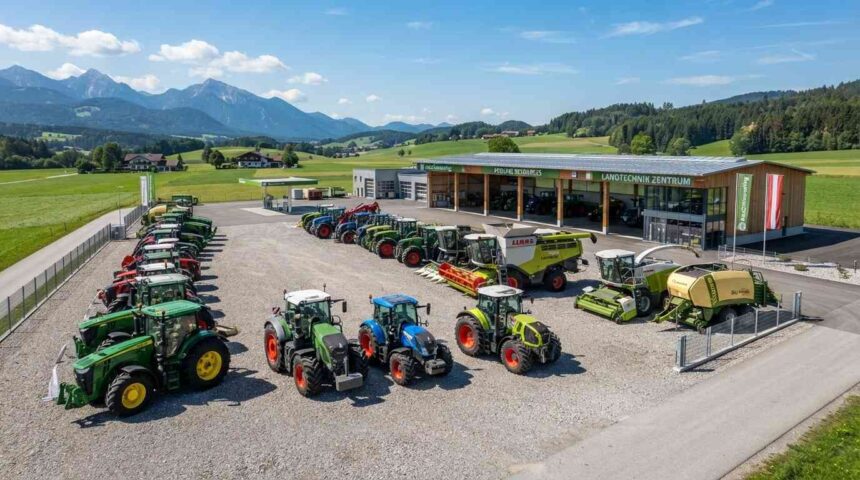
If you searched “maschinenring mining” expecting a company that digs up coal, ore, or crypto, you can relax. Maschinenring Mining has nothing to do with mineral extraction. It refers to a branch of the Maschinenring, an Austrian agricultural service cooperative, located in a small town literally named Mining.
That single English word trips up almost everyone who lands here. In German, “Mining” is just a place name in Upper Austria. The organization sitting there shares farm machinery, provides rural services, and supplies workers to local businesses.
This guide clears up the confusion in plain language. We’ll cover what the town of Mining actually is, what the Maschinenring cooperative does, how its famous machinery-sharing model works, and why a 1960s farming idea still matters today.
One quick note before we start: this article is for general information only. For membership, pricing, or contract details, contact the cooperative directly.
Quick Answer
Maschinenring Mining is not a mining business. “Mining” is a small municipality in Upper Austria, and Maschinenring is an agricultural service cooperative. The branch there is called Maschinenring Braunau und Umgebung, based at Hofmark 5, 4962 Mining.
Here are the takeaways worth remembering:
- It’s agriculture, not industry. The name has zero connection to mineral or crypto mining.
- It’s part of a national network. There are 80 Maschinenring cooperatives across Austria with 70,000 members and 30,000 workers.
- It shares machines and people. Members pool costly equipment, provide services, and take on temporary work.
- It serves everyone rural. Customers include farmers, municipalities, companies, and private individuals, mostly in rural areas.
Why “Maschinenring Mining” Confuses People
The trouble is one word doing two jobs. English readers see “mining” and think shovels, tunnels, and ore. Here it’s a proper noun, the name of a village.
Mining is a municipality of 1,307 residents (as of January 1, 2025) in the northeast of the Braunau am Inn district in Upper Austria. It sits along the state border with Germany on a terraced landscape shaped during the Ice Age, above the Inn reservoir. The local cooperative office is at Hofmark 5, 4962 Mining.
Search engines and auto-translation tools spread the mix-up further. Type the phrase into Google, and you’ll bounce between German corporate pages, business directories, and map listings, none of which explain the naming quirk in English.
Picture a researcher in London hunting for an Austrian mining firm’s contact details. They find a page about winter road clearing and tree care, get baffled, and click away. If that was you, you’re in good company, and this article is the fix.
Read Also: Nerwey
What Maschinenring Actually Is
A Maschinenring (literally “machine ring”) is a cooperative where farms join forces to share machinery and labor. Farmers band together to use machines and workers jointly, cutting costs and boosting efficiency.
The idea started as bäuerliche Selbsthilfe, or “farmer self-help.” Erich Geiersberger founded the first organization of this kind in 1958 in Buchhofen, Bavaria. The model spread quickly across Austria and much of Europe, because the problem it solved was everywhere: modern machines were expensive, and small farms couldn’t justify buying their own.
Today the Austrian network runs on three core business areas:
- Agrar – farm-to-farm machinery and services.
- Service – work for towns, businesses, and private clients.
- Personal – staffing and temporary labor.
The scale is real. According to the official Maschinenring website, membership sits stably above 70,000, and the 80 Maschinenring cooperatives cover agricultural services plus the Service and Personal divisions. As Prima Magazin reports, the organization now counts 70,000 members in Austria and generates 400 million euros in revenue. Strikingly, more than half of Austria’s farmland is worked by Maschinenring members.
Read Also: Miuzo
Maschinenring Braunau und Umgebung: The Branch in Mining
The branch physically located in Mining is Maschinenring Braunau und Umgebung. It serves farmers across the wider Braunau region, plus municipalities, regional companies, and private households.
The mix of customers matters. A dairy farmer might book a specialist harvester through it. The local town might hire its crews to clear snow. A factory might bring on seasonal workers through its staffing arm.
Here’s a concrete example of how the model earns members extra income. Through the cooperative, farmers work winter road clearing for municipalities, maintain green spaces, or take jobs at regional industrial firms via Maschinenring Personal, and they’re always properly and fully insured.
On the practical side, the office keeps regular weekday hours and is reachable by phone and email. Its legal form is a registered association (Verein), with the address at Hofmark 5, 4962 Mining. For anything specific, the local team handles direct inquiries.
Read Also: Lamps4u
How the Machinery-Sharing Model Works
Expensive equipment becomes affordable when farms share it instead of each buying its own. That’s the whole engine behind the cooperative.
The formal version is called a Maschinengemeinschaft, a machinery-sharing group. Several farmers jointly buy a high-cost machine and schedule its use across their farms. Joint purchasing of equipment is growing in importance, and the cooperative initializes, develops, and coordinates these groups.
Think about a small farm eyeing a combine harvester it would use just a few weeks a year. Buying alone rarely pays off. Five farms sharing one machine spread the cost, keep it busy, and each gets modern kit they couldn’t afford solo.
Coordination is where the ring adds value. If a service provider drops out or a machine breaks, the cooperative arranges a replacement, saving members hassle and time. Digital booking tools help reduce downtime and keep machines earning.
Is it cheaper to share farm machinery than to buy it? For occasional-use equipment, sharing usually wins. This table breaks down why:
| Factor | Buying Alone | Sharing Through Maschinenring |
|---|---|---|
| Upfront Cost | Full price paid by one farm | Split across several farms |
| Yearly Usage Rate | Often low; idle much of the year | High; machine stays busy |
| Maintenance Burden | Falls entirely on the owner | Shared or coordinated |
| Access to Modern Equipment | Limited by budget | Broad, through the pool |
| Financial Risk | Concentrated on one farm | Spread across the group |
Services Beyond Farming
The cooperative long ago outgrew pure machinery sharing. It’s now a full rural and municipal service provider.
The Service division covers a lot of ground. Offerings include winter road clearing, green space services, tree care and tree management, garden and landscape construction, and forestry. The Braunau branch also handles biomass and wood-chip energy. It’s one of the largest biomass producers in Austria, offering wood chips, firewood, miscanthus pellets, and energy crops.
Then there’s the staffing arm, Personal (Arbeitskräfteüberlassung). It supplies reliable rural workers to regional businesses and public bodies. Regional companies, municipalities, and private households value Maschinenring’s farm and forestry workers for their reliability, flexibility, and commitment.
Landscape and infrastructure work rounds it out. The cooperative offers municipalities and tourism organizations everything from one source, including maintaining hiking trails, repairing signage, clearing storm damage, and larger landscaping work on infrastructure projects.
Read Also: Stormuring
Why This Cooperative Model Still Matters
A 1960s idea survives because the underlying problem never left. Equipment is still costly, farm margins are still thin, and rural labor is still scarce. Pooling resources answers all three at once.
The payoff reaches beyond individual farms. By opening up varied earning options, the cooperative supports regional value creation, preserves smaller farm structures, and secures jobs. That keeps part-time and small farms viable and strengthens rural economies.
There’s a lesson here for any business reader. Shared assets and cooperation can cut costs and spread risk in almost any industry, not just farming. It’s the same logic behind equipment pools, shared workspaces, and buying groups.
The durability shows in its reach. Maschinenring exists in Germany, France, the UK, Luxembourg, Switzerland, Austria, Hungary, Italy (South Tyrol), Norway, Sweden, Finland, Latvia, and Slovenia, plus Brazil, Japan, Australia, and Senegal. Since summer 2024 it even has a world association spanning fifteen European and African nations.
Read Also: Babeltee
The Bottom Line
Stop looking for a mine. Maschinenring Mining is simply the Austrian farm cooperative Maschinenring Braunau und Umgebung, based in the village of Mining. If you were researching a mineral business, redirect your search; if you were curious about the cooperative, you now know it shares machines, runs rural services, and staffs local jobs.
Want to see the real thing? Visit the official Maschinenring website or the Mining municipality page for verified, up-to-date details.
FAQ
Is Maschinenring Mining related to mineral or crypto mining?
No. “Mining” is the name of an Austrian town, not an activity. Maschinenring is a farming cooperative, and its branch there is Maschinenring Braunau und Umgebung. There’s no connection to mineral extraction or cryptocurrency.
Where is Mining, Austria located?
Mining is a small municipality in the Braunau am Inn district of Upper Austria, in the country’s northeast, sitting on the state border with Germany above the Inn reservoir. The regional capital Linz is roughly 95 kilometers away.
What does Maschinenring do?
It runs three business areas: farm-to-farm machinery services (Agrar), work for towns, companies, and private clients (Service), and staffing (Personal). Alongside providing farm machinery, it offers landscape care, winter service, forestry, and more for members and non-members alike.
Who can use Maschinenring services?
Customers include farmers, municipalities, companies, and private individuals, mostly in rural areas. Both members and non-members can use services, though pricing differs. Non-members pay an additional non-member surcharge.
When and why was Maschinenring founded?
The first machine ring began as a farmer self-help association to share costly equipment. Erich Geiersberger founded the first one in 1958 in Buchhofen, Bavaria, and the Austrian rings grew from the 1960s. The goal was simple: make expensive machinery affordable by sharing it.
How big is Maschinenring in Austria?
According to the official website, there are 80 Maschinenring cooperatives in Austria with 70,000 members and 30,000 workers. More than half of Austria’s farmland is worked by its members.
How does a machinery-sharing group (Maschinengemeinschaft) work?
Several farmers jointly buy a high-cost machine and schedule its use among themselves. The cooperative initializes, develops, and coordinates the group, handling billing and arranging replacements if a machine fails, so no single farm carries the full cost or risk.
Is Maschinenring only in Austria?
No. It operates in Germany, France, the UK, Switzerland, Italy (South Tyrol), and several other European countries, plus Brazil, Japan, Australia, and Senegal. The Austrian branch in Mining is just one piece of a much larger international network.
For more quality, informative content, visit writewhiz.