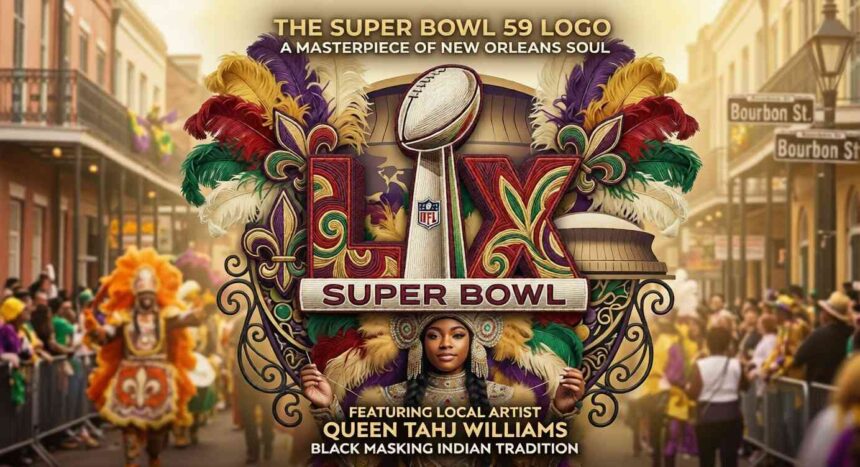
The Super Bowl 59 Logo: The Story, the Art, and the New Orleans Soul Behind NFL’s Most Meaningful Badge
If you’ve been following the buzz around Super Bowl LIX, you already know that the Super Bowl 59 logo isn’t just another piece of NFL branding slapped together in a design studio. This one is different — deeply personal, rooted in a centuries-old cultural tradition, and crafted by a 26-year-old New Orleans artist who quite literally built it bead by bead. From the moment the NFL unveiled it, fans, designers, and cultural commentators couldn’t stop talking about it. And once you understand the full story behind it, you’ll see exactly why.
This article breaks down everything you need to know — the design itself, the remarkable woman who created it, the cultural tradition it honors, how it stacks up against previous Super Bowl logos, and why it represents a turning point in how the NFL approaches branding and community.
What Is the Super Bowl 59 Logo and Why Does It Matter?
The Super Bowl 59 logo is the official visual identity for Super Bowl LIX, which was held on February 9, 2025, at Caesars Superdome in New Orleans, Louisiana. The game saw the Philadelphia Eagles face off against the Kansas City Chiefs, with the Eagles claiming a dominant victory — but before a single play was run, the logo alone had already made history.
What sets this logo apart from every previous Super Bowl emblem is its origin. For the first time in the history of the event, the NFL commissioned a local New Orleans artist to create the design. Not a corporate branding agency. Not an in-house NFL design team. A real person from the community, with deep cultural roots in the city that was hosting the game. That decision changed everything about what the logo means and how it looks.
Official Reveal and First Look
The Super Bowl LIX logo was officially revealed in early 2024, giving fans and the broader public more than a year to appreciate it before the game itself. The unveiling was accompanied by an explanation of the design’s inspiration, which immediately drew widespread attention — not just from football fans but from the art world and cultural commentators who recognized the significance of what the NFL had done.
The Logo Template: A Tradition Since Super Bowl LVI
Since Super Bowl LVI in 2022, the NFL has followed a consistent design template for its championship logos. Each logo centers the Roman numerals of the game prominently, incorporates the Vince Lombardi Trophy as a focal element, and uses color and texture to reflect the host city’s identity. What changes from year to year is the cultural soul poured into those consistent elements — and for Super Bowl LIX, that soul came from one of New Orleans’ most vibrant and sacred traditions.
The Artist: Who Is Queen Tahj Williams?
The name behind the Super Bowl 59 logo is Queen Tahj Williams — and her title isn’t ceremonial. She is a reigning queen of the Golden Eagles, one of New Orleans’ most celebrated Black Masking Indian tribes. At just 26 years old at the time of the commission, she brought not only artistic talent but a lifetime of cultural immersion to the project.
Growing Up Inside the Black Masking Indian Tradition
To understand what Queen Tahj Williams brought to this logo, you first need to understand the world she grew up in. The Black Masking Indians — also known as Mardi Gras Indians — are African American community organizations in New Orleans with roots going back more than a century. Each year, tribe members spend months, sometimes the entire year, hand-sewing elaborate ceremonial suits covered in intricate beadwork, feathers, and rhinestones. These suits are not manufactured. Every single bead is placed by hand, and the process is a profound act of cultural preservation, spiritual practice, and artistic expression.
Williams grew up participating in this tradition. She didn’t just study it academically or appreciate it from the outside — she lived it, season after season, learning the painstaking craft of beadwork that would ultimately define the Super Bowl LIX logo’s visual language.
Why the NFL Chose Her
The NFL’s decision to choose a local New Orleans artist for the first time was deliberate and meaningful. Rather than importing a design sensibility onto the city, the league chose to let the city speak for itself. Williams was selected because she represented both technical mastery and authentic cultural connection. The result is a logo that doesn’t just reference New Orleans — it embodies it.
Breaking Down the Super Bowl LIX Logo Design
Look closely at the Super Bowl 59 logo and you’ll find layers of meaning in every element. Nothing is decorative for its own sake. Every line, texture, and color carries intention.
The Roman Numerals LIX and Their Beadwork Texture
The letters “LIX” dominate the logo, as they do in every modern Super Bowl design. But here, the numerals aren’t rendered in a clean, corporate font. They carry a textured, almost three-dimensional quality that evokes the handcrafted beadwork of Black Masking Indian ceremonial suits. When you see the logo in high resolution, it feels less like a graphic design and more like something that could be carefully unstitched from fabric — because in spirit, that’s exactly what it is.
The Vince Lombardi Trophy
Centered within the design is the Vince Lombardi Trophy, the ultimate prize in professional football. Its placement is consistent with recent Super Bowl logos, but the surrounding aesthetic transforms it. Instead of sitting against a sterile background, it’s framed by ornamental detail that feels warm, handmade, and alive — a deliberate contrast to the trophy’s cold silver surface.
Color Palette and What Each Color Represents
The colors chosen for the Super Bowl LIX logo are not arbitrary. They reflect both the spirit of New Orleans and the visual language of the Black Masking Indian tradition.
| Color | Significance |
|---|---|
| Deep Burgundy / Red | Black Masking Indian ceremonial suits; energy and passion |
| Rich Gold | Vince Lombardi Trophy; New Orleans Saints’ team colors |
| Emerald Green | Mardi Gras tradition; Louisiana’s natural landscape |
| Ivory / Cream | Feather elements in Indian suits; elegance and craftsmanship |
| Royal Purple | Mardi Gras royalty; New Orleans carnival heritage |
Together these colors create a palette that feels festive without being frivolous — celebratory in the way New Orleans itself is celebratory: with depth, history, and soul underneath the spectacle.
Fleur-de-Lis and French Quarter Ironwork
Woven into the border and surrounding ornamental elements of the logo are references to the fleur-de-lis, the symbol most closely associated with New Orleans and its French colonial history. The fleur-de-lis is also the emblem of the New Orleans Saints, making its presence feel like a natural bridge between the host city’s identity and its NFL franchise. Alongside it, the ornate curling patterns echo the wrought-iron balcony railings that define the architecture of the French Quarter — details that a designer unfamiliar with New Orleans would likely never think to include.
The Cultural Significance of the Super Bowl 59 Logo
It would be easy to look at the Super Bowl 59 logo and see a beautiful piece of graphic design. But reducing it to that would miss the point entirely. This logo is a cultural statement.
The Black Masking Indian Tradition Explained
The Black Masking Indians of New Orleans have their roots in solidarity between African American and Native American communities in Louisiana — a history that stretches back to the era of slavery, when Indigenous peoples provided refuge and support to escaped enslaved people. Over generations, that alliance evolved into a rich ceremonial tradition where African American community members honor Native American heritage through hand-crafted suits of extraordinary beauty.
The tradition is kept alive almost entirely through community effort. There are no government grants funding the suits. No corporate sponsors. The beadwork, featherwork, and rhinestone patterns are passed down through families and tribes, sustained by love, pride, and an unbreakable commitment to cultural memory. When Queen Tahj Williams embedded this tradition’s visual language into an NFL logo seen by over 100 million people globally, she gave that community its largest stage in history.
A Historic Milestone for NFL Branding
The NFL is not an organization historically known for centering local culture in its marketing. Super Bowls have been held in cities for decades, and the logo designs — while always incorporating the host city’s name — rarely reflect the city’s living cultural identity. Super Bowl LIX changed that. It set a precedent that future host cities and communities will rightly point to when advocating for authentic representation.
How the Super Bowl 59 Logo Compares to Recent Super Bowl Logos
Placing the Super Bowl LIX logo in context alongside its recent predecessors helps illustrate just how distinct it really is.
| Super Bowl | Year | Host City | Logo Theme | Designed By |
|---|---|---|---|---|
| LVI | 2022 | Los Angeles | Hollywood glamour, sunshine | NFL brand team |
| LVII | 2023 | Glendale, AZ | Desert landscape, Southwest colors | NFL brand team |
| LVIII | 2024 | Las Vegas | Neon lights, entertainment strip | NFL brand team |
| LIX | 2025 | New Orleans | Black Masking Indian beadwork, Mardi Gras | Queen Tahj Williams (local artist) |
The pattern is clear. Super Bowls LVI through LVIII each leaned on their host city’s most obvious, commercially recognizable identity. Los Angeles got Hollywood. Las Vegas got neon. New Orleans could easily have gotten jazz music notes or a generic Mardi Gras mask. Instead, it got something far more authentic — a design rooted in a tradition most people outside Louisiana had never encountered before.
Where You’ve Seen the Super Bowl LIX Logo
Once the Super Bowl 59 logo was officially released, it appeared across every official NFL touchpoint leading up to game day. Digital tickets for the event featured the logo prominently on their face. The official Super Bowl LIX game program used it as the cover image. The exterior of the Hyatt Regency New Orleans was adorned with large-scale reproductions of the logo in the weeks approaching the game. Official merchandise — jerseys, hats, collectibles — all bore the design. And on broadcast, every pre-game and halftime segment featured it as a visual anchor.
Beyond official channels, the logo achieved something rare in sports branding: it went genuinely viral in design and cultural communities. Graphic designers praised its textural richness. Cultural journalists wrote about its historical significance. Social media posts explaining the Black Masking Indian tradition accumulated millions of views, many of them tracing back directly to curiosity sparked by the logo.
Fan and Media Reaction
The response to the Super Bowl 59 logo was overwhelmingly positive, and notably more emotionally engaged than the typical reception to sports branding. Most Super Bowl logos generate mild appreciation at best. This one generated pride — particularly among New Orleans residents and members of the Black Masking Indian community, who saw their tradition acknowledged on the world’s biggest sporting stage.
Media coverage went well beyond the sports press. Cultural publications, design magazines, and outlets focused on African American history all ran features on Queen Tahj Williams and the tradition her work represented. For many readers, the logo became an entry point into learning about a living piece of American cultural history they had never previously encountered.
Conclusion
The Super Bowl 59 logo is more than a badge on a piece of merchandise. It is a handcrafted love letter to New Orleans — its history, its people, and a tradition that has survived centuries through sheer communal will. By choosing Queen Tahj Williams, a young Black Masking Indian queen from the very city hosting the game, the NFL made a decision that elevated its branding from commercial to genuinely meaningful. The design’s beadwork textures, its Mardi Gras color palette, its fleur-de-lis details, and its roots in the Black Masking Indian tradition all combine to create something that will be remembered long after the Eagles’ victory score has faded from casual memory. If this logo signals a new direction for how the NFL approaches host city identity, that is a very good thing for the game, for American culture, and for the communities whose stories deserve to be told on a stage this large.
Frequently Asked Questions
Who designed the Super Bowl 59 logo? The Super Bowl LIX logo was designed by Queen Tahj Williams, a 26-year-old New Orleans artist and reigning queen of the Golden Eagles, one of the city’s most respected Black Masking Indian tribes. She was the first local community artist ever commissioned to design a Super Bowl logo in the event’s history.
What cultural tradition inspired the Super Bowl 59 logo? The design draws directly from the Black Masking Indian — also called Mardi Gras Indian — tradition of New Orleans. This centuries-old practice involves African American community members creating elaborate hand-beaded ceremonial suits as an act of cultural preservation and tribute to historical alliances between African American and Native American communities in Louisiana.
What do the colors in the Super Bowl LIX logo represent? The logo’s color palette was deliberately chosen to reflect both the Black Masking Indian ceremonial tradition and the broader identity of New Orleans. Deep burgundy and red reference the energy of the Indian suits. Gold ties to the Vince Lombardi Trophy and the New Orleans Saints. Emerald green and royal purple honor the Mardi Gras tradition, and ivory cream echoes the featherwork found in ceremonial costumes.
When was the Super Bowl 59 logo officially revealed? The Super Bowl LIX logo was officially revealed in early 2024, approximately one year before the game took place on February 9, 2025, at Caesars Superdome in New Orleans, Louisiana.
Is the Super Bowl 59 logo design hand-made? While the final logo exists as a digital graphic used across official NFL materials, its visual language is rooted in hand-crafted beadwork. Queen Tahj Williams drew directly from her lived experience creating hand-beaded Black Masking Indian suits, and the textured, layered quality of the logo reflects that handmade aesthetic throughout its design.
For more quality, informative content, visit writewhiz