



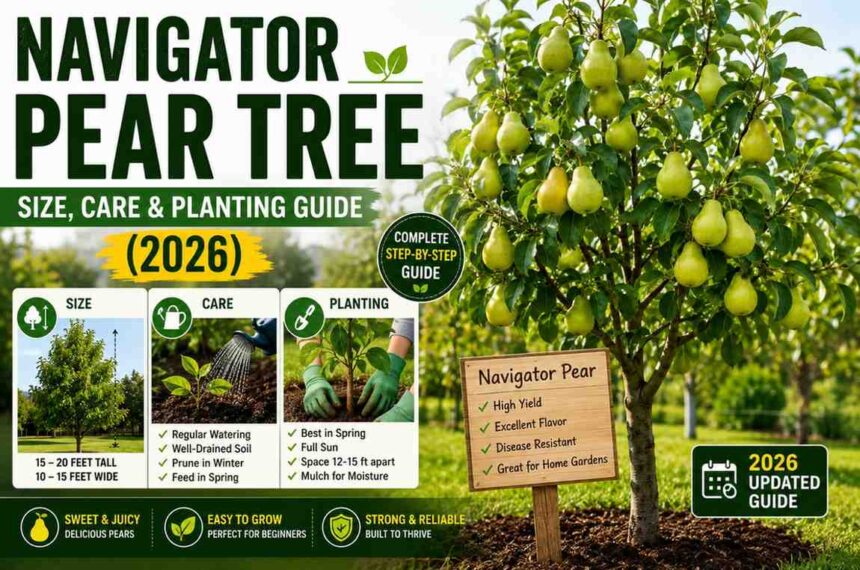
The navigator pear is an upright, cold-hardy ornamental pear tree, usually sold asPyrus x ‘DurPSN303’, grown for its white spring flowers, glossy summer leaves, and yellow-orange fall color rather than fruit you can eat. If you want a narrow, tidy flowering tree for a front yard or tight urban spot, it is worth a look, but its true size and a few regional rules deserve a careful read first.
This is general horticultural guidance, not a planting mandate for your exact address. Before you buy, confirm local planting and invasive-species rules with your regional extension office or garden authority, since some ornamental pears face restrictions in certain areas.
You are in the right place if you are trying to decide whether this tree fits your yard and how to grow it well. Below, we cover what it actually is, its real mature size, where and how to plant it, season-by-season care, common problems, and strong alternatives if it turns out not to be the right pick.
What Is the Navigator Pear?
The Navigator Pear is an ornamental, or landscape, pear grown for looks rather than harvest. Most nurseries list it as Pyrus x ‘DurPSN303’ and market it as the Navigator ornamental pear.
It sits in the broader ornamental pear group tied to Pyrus calleryana , the Callery pear, which is originally from Asia and part of the rose family, Rosaceae. Callery pear is native to China and Taiwan, and it is an upright-branched ornamental tree that grows pyramidal to columnar in youth, noted for its early spring bloom, glossy green foliage, and often excellent fall color.
Here is an honest heads-up on the name. Most trusted listings describe the Navigator as a fruitless-to-minimal-fruit ornamental. One nursery profile lists it as a medium-sized tree with a strong, upright crown, white flowers that give rise to small one-inch fruit, and yellow-orange fall color. A few scattered sources instead describe an edible, European-style pear (Pyrus communis). The fix is simple: check the botanical name and the nursery description so you buy the exact tree you want.
Picture this common mix-up. A reader dreams of bowls of fresh pears off the branch. That reader wants a fruiting cultivar like Bartlett , Bosc , or Anjou, not the Navigator. When you shop for the Navigator, compare it to other flowering landscape trees, not to dessert pears.
Navigator Pear Size and Growth Habit
Nursery listings vary widely, so treat the Navigator pear as a medium-sized upright ornamental tree and plan for the larger estimate. That single planning habit saves you from crowding a driveway, sidewalk, foundation, fence, or overhead power line years down the road.
Why does the range matter so much? A tree squeezed into a cold, dry, or exposed site tends to stay smaller, while a tree in deep, well-watered soil reaches the top of its range. If you plant for the smallest number and the tree hits the largest, you inherit years of pruning headaches.
The published sizes really do disagree. Here is how the numbers stack up by source.
| Source Type | Height | Spread | Notes |
|---|---|---|---|
| Smaller nursery listing (Blue Grass Nursery) | 20-23 ft | 10-13 ft | Narrow, well-shaped tree for small spaces |
| Plant-finder network (many garden centers) | ~26 ft | 12-13 ft | Low canopy; keep clear of power lines |
| Grower introduction (Jeffries / Prairie Shade) | ~35 ft | ~18 ft | Listed as a medium tree with a strong upright crown |
Those ranges are real. One nursery lists a mature size of about 6 to 7 meters (20 to 23 feet) tall with a spread of 3 to 4 meters (10 to 13 feet). A widely syndicated plant-finder listing puts it at about 26 feet tall with a 13-foot spread, with a low canopy that should not be planted underneath power lines. Meanwhile, the grower’s own profile lists height at 35 feet and spread at 18 feet.
So how big does a Navigator pear get? Somewhere between a tidy 20 feet and a solid 35 feet, depending on the source and your site. Plan for the taller figure.
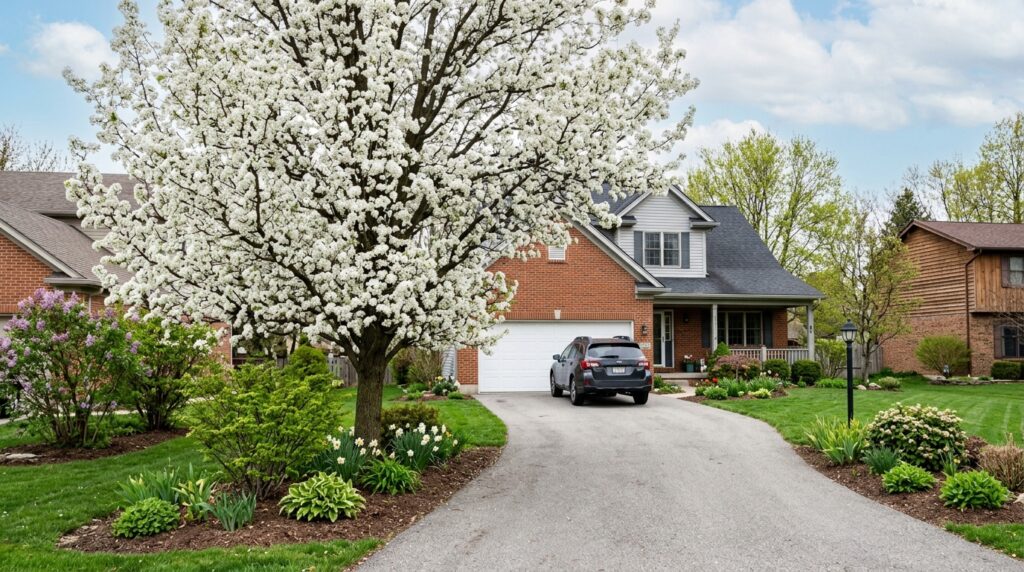
The habit is the real selling point. Expect a compact, pyramidal to upright or columnar form , glossy heart-shaped leaves, white spring blossoms, and yellow to orange (sometimes red) fall color, with strong winter structure once the leaves drop. The cultivar is prized for an elegant pyramidal form, bright white blossoms in early to mid-spring followed by glossy heart-shaped green leaves, a vibrant autumn transition, and attractive winter structure, with a compact, pyramidal, and upright growth habit.
Where and How to Plant a Navigator Pear
Give the navigator pear full sun (at least six hours), average to moist but well-drained soil, and enough room for the mature canopy and roots. Those three things do most of the work. Callery-type pears grow best in humusy, well-drained loams with consistent moisture in full sun, tolerate some drought once established, adapt to a wide range of soils including heavy clays, and generally tolerate urban conditions.
Use it as a vertical accent tree , a front-yard specimen, or a boulevard tree where its narrow shape shines. Keep it away from foundations and hard surfaces given the mature size, and never plant it directly under power lines. Many garden centers flag exactly that point: it has a low canopy and should not be planted underneath power lines.
Here is a simple planting method drawn from the Royal Horticultural Society’s tree-planting guide:
- Dig a hole about 1.5 to 3 times the width of the root ball and no deeper than the root collar. Dig a planting hole that is no deeper than the roots, but is ideally at least three times the diameter of the root system.
- Loosen any circling or potbound roots so they grow outward into the soil.
- Set the tree straight, with the flare where roots meet the trunk level with the soil surface. Position it so the first flare of roots is level with the soil surface, because deep planting prevents air movement to the roots and makes the lower trunk vulnerable to disease.
- Backfill with the native, loamy soil and firm it gently to remove air pockets. Refill the planting hole carefully, placing soil between and around all the roots to eliminate air pockets.
- Water in well, then spread a 2 to 3 inch mulch layer, keeping it a few inches off the trunk. Spread a mulch of organic matter 5 to 8 cm (2 to 3 in) thick, leaving a 10 cm (4 in) mulch-free gap around the base of the trunk.
The most common mistake is planting too deep or dropping the tree into heavy, waterlogged clay. Both invite root rot. What if your yard puddles after rain? Improve the drainage first, plant on a slight mound if needed, and never bury the root collar.
Caring for Your Navigator Pear Through the Seasons
Water regularly while the tree establishes, mulch each year, prune for structure in late winter, and feed lightly in spring. That short routine covers most of what a navigator pear needs.
Watering matters most in the first one to three years. During the first two years after planting, new trees need thorough watering in dry spells to ensure the water reaches the full depth of the root system. Once mature, the tree handles drought fairly well but still appreciates a deep soak during long dry spells. Avoid drowning it with daily light sprinkles.
Mulch and feeding are light-touch jobs. Keep a 2 to 3 inch mulch ring, pulled back a few inches from the bark, and top it up once a year. A balanced slow-release fertilizer in early spring is plenty. Go easy on high-nitrogen feeds, since too much nitrogen pushes leafy growth at the expense of flowers.
Pruning is best in late winter or early spring, before bud break. Remove dead, damaged, crossing, and competing branches, and train young trees early to build a strong framework. This is where you head off the weak-limb reputation that haunts older ornamental pears. Some nurseries rate the tree as higher-maintenance and expect regular upkeep, so plan for a yearly check.
A quick note from real-world planting: in windy, exposed sites, stake a young tree until its roots anchor, then remove the stake so the trunk can strengthen. Keep the stake in place for two to three years until the tree is firmly rooted, since a stake prevents wind rock and helps the young tree establish well.
Read Also: Pravi Celer
Common Problems and the Ornamental Pear Question
The navigator pear is generally hardy, but it shares the ornamental pear family’s known concerns:fire blight and other diseases, possible structural weakness, and regional invasiveness worries tied to Callery-type pears. Knowing these upfront helps you decide with clear eyes.
On pests and diseases, watch for aphids, scale, borers, leaf spot, scab, rust, and especially fire blight, a bacterial disease in the rose family. Inspect the tree regularly. For fire blight, prune out affected wood well below the visible damage and sterilize your tools between cuts. For minor pest flare-ups, horticultural oil or insecticidal soap usually does the job. Fire blight susceptibility varies by cultivar, and even well-regarded ornamental pears differ, as the Missouri Botanical Garden notes that the ‘Chanticleer’ pear resists fire blight in northern areas and is much stronger against limb breakage than ‘Bradford’, though it is still susceptible to splitting from strong wind, snow, or ice.
That storm-breakage risk is the structural catch. Older ornamental pears became known for weak branch angles and limbs that split in storms. The ‘Bradford’ pear is particularly prone to breakage from wind, snow, or ice, is now frequently not recommended by nurseries, and may need replacing in 15 to 20 years. Early formative pruning on your Navigator lowers that risk a lot.
Now the bigger question, invasiveness. Some Callery pear cultivars escape cultivation, cross-pollinate, and form dense wild thickets that crowd out native plants. Callery pear forms dense thorny thickets, produces flowers with an offensive odor, and drops large amounts of fruit. Several U.S. states have acted on this. It is now illegal to sell, grow, or plant Callery pear in Ohio because of its invasive qualities. Missouri passed Senate Bill 105, which bans nurseries from importing, exporting, buying, or selling Callery pear, and it passed 124 to 19. In Illinois, Callery pear becomes illegal to buy, sell, distribute, or plant on January 1, 2028, after a grace period.
The Navigator is sold under its own cultivar name, not simply as Bradford pear, so it is not automatically on those lists. Even so, the smart move is to ask your local extension office or nursery whether ornamental pears are recommended, discouraged, restricted, or banned where you live.
Here is a “what if” worth walking through. Imagine a reader in a state weighing a Callery pear restriction. They call the county extension office, learn the tree is discouraged locally, and choose a native flowering tree instead. In several regions, groups even give out free native trees like redbud and serviceberry to people who remove a Callery pear, as the USDA’s invasive species center and state programs describe. One phone call spared that reader a costly mistake.
Navigator Pear vs Other Flowering Trees
Judge the navigator pear against other spring-flowering landscape trees, not dessert pears. That comparison is where it earns or loses its spot in your yard. Other trees with white flowers in early spring include black cherry, chickasaw plum, crabapple, serviceberry, and flowering dogwood.
Here is how the Navigator stacks up against popular options.
| Tree | Mature Size | Key Feature | Best For | Notes |
|---|---|---|---|---|
| Navigator pear | ~20-35 ft | Narrow upright form, white blooms, fall color | Vertical accent, boulevard | Ornamental pear; check local rules |
| Chanticleer / Cleveland Select pear | ~25-35 ft | Tidy pyramidal shape, fire-blight resistant | Street tree, narrow sites | Still a Callery cultivar |
| Serviceberry (Amelanchier) | ~15-25 ft | White blooms, edible berries, wildlife value | Small spaces, native gardens | Native, supports pollinators |
| Eastern redbud (Cercis canadensis) | ~20-30 ft | Pink-purple spring flowers | Utility-line sites, small yards | Native, wildlife friendly |
| Crabapple (Malus spp.) | ~15-25 ft | Showy blooms, colorful fruit | Specimen, pollinator support | Choose disease-resistant types |
| Flowering dogwood (Cornus florida) | ~15-30 ft | Spring bracts, red fall color | Understory, part shade | Native, four-season interest |
If your region discourages ornamental pears, the native picks solve two problems at once. Serviceberry andredbud suit smaller spaces and utility-line sites, and they feed local birds and insects in a way Callery-type pears do not. In some areas, groups give out free native alternatives such as redbud and serviceberry to homeowners who cut down a Callery pear.
The Bottom Line
Plant the navigator pear only after you confirm two things: your region allows ornamental pears, and your chosen spot has room for a tree that may reach 35 feet with full sun and good drainage. If both check out, you get a clean, narrow flowering tree with strong four-season appeal, as long as you prune it early for structure.
Your single clearest next step is one phone call or email to your local cooperative extension office or a trusted nursery to ask whether ornamental pears are recommended in your area. If the answer is no, pick a native like serviceberry or redbud and plant with confidence.
FAQ
Is the Navigator Pear tree edible?
The navigator pear is grown as an ornamental for its flowers and form, not for fruit. Any fruit it sets is small and minimal, roughly one inch across. If you want pears to eat, choose a fruiting cultivar like Bartlett, Bosc, or Anjou instead.
How big does a Navigator Pear get?
Listings range from about 20 to 23 feet up to roughly 35 feet tall, with spreads from about 10 to 18 feet. Some list it around 23 to 26 feet tall, while others list it closer to 35 feet tall and 18 feet wide, and that difference matters near driveways, sidewalks, foundations, fences, or utility lines. Plan for the larger size to be safe.
Is the Navigator Pear the same as a Bradford pear?
No. The Navigator is sold as Pyrus x ‘DurPSN303’, while Bradford is a well-known ** Callery pear** cultivar. Both sit within the broader ornamental pear discussion, so local invasive-plant rules and nursery recommendations still apply to both.
Is the Navigator Pear invasive?
It is not automatically listed on state bans, which target Callery pear broadly. Still, it belongs to the same ornamental pear group, and several U.S. states have banned or restricted the sale and planting of Callery pear because of its invasive tendency and impact on native ecosystems. Confirm your regional restrictions before planting.
Is the Navigator Pear messy?
It is fairly clean. Because it sets only small, minimal fruit, you get far less fruit drop than a large fruiting tree, so cleanup is light. Expect the usual seasonal leaf and petal drop, and little more.
When and how should I prune a Navigator Pear?
Prune in late winter or early spring, before bud break. Remove dead, damaged, crossing, and competing branches, and train young trees early to build a strong framework. Prune as needed in winter to reduce the risk of storm breakage later.
What hardiness zones suit the Navigator Pear?
It is bred to be cold-hardy, and one grower rates it as hardy to USDA zone 2, which is unusually tough for an ornamental pear. Callery-type pears in general perform across a wide range of zones. Always check the specific cultivar tag at purchase to confirm the zone for your area.
What are good alternatives to the Navigator Pear?
Strong flowering options include serviceberry , Eastern redbud, crabapple , and flowering dogwood. Serviceberry and redbud are native, suit small or utility-line sites, and support birds and pollinators, which makes them ideal where ornamental pears are discouraged.
For more quality, informative content, visit writewhiz.