



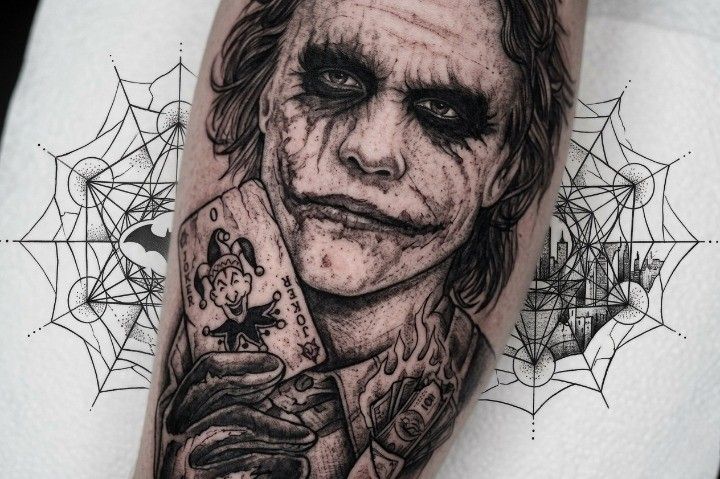
Joker Tattoo Meaning: Symbolism, Designs & What It Really Says About You
There’s something about the Joker that refuses to stay quietly on a movie screen or comic book page. The character crawls under your skin — sometimes literally. If you’ve been researching the joker tattoo meaning before committing to your next piece of ink, you’ve probably noticed that the answers you find are either maddeningly vague (“it means chaos!”) or so shallow they tell you nothing useful. The truth is that this tattoo carries one of the richest, most layered symbol systems in all of body art, and what it means depends heavily on which version of the Joker you’re drawn to, how the design is executed, and where you choose to place it. This guide covers all of it — the history, the symbolism, the design variations, the viral internet interpretations, and everything in between.
What Does a Joker Tattoo Mean? The Real Answer
At its most fundamental level, a joker tattoo is a declaration that you understand life isn’t a neat, orderly affair — and that you’ve made peace with that. The character has always embodied the tension between opposing forces: laughter and grief, sanity and madness, villainy and a strange, twisted kind of honesty. People who wear this ink aren’t always drawn to darkness for its own sake. More often, they’re drawn to the Joker because he’s one of fiction’s rare characters who never pretends the world is something it isn’t.
That said, the symbolism isn’t monolithic. Someone who chooses a Heath Ledger-inspired design is communicating something quite different from someone who gets a traditional playing card joker etched on their forearm. A person who inks “Why so serious?” across their collarbone is speaking a different emotional language than someone who goes for a full Joaquin Phoenix portrait with smeared red paint and hollow eyes. To understand what a joker tattoo genuinely represents, you have to look at the layers — and there are more of them than most people expect.
The Ancient Roots of the Joker Symbol
Before the Caped Crusader ever set foot in Gotham City, the joker already carried centuries of meaning. The figure most people associate with the Joker traces directly back to the medieval court jester — the fool in the king’s court who was, paradoxically, the most psychologically free person in the room. Court jesters were granted a unique license: they could mock royalty, expose hypocrisy, and speak uncomfortable truths under the protection of comedy. Everyone else bowed and flattered. The jester told the king he was wrong — and got away with it, because the laughter softened the blow.
This is a deeply important piece of context for anyone considering joker tattoo symbolism. When you trace the design back to the jester, the meaning shifts from simple chaos to something more nuanced: the idea that the fool is often the wisest person in the room, and that humor is a form of resistance. The jester used absurdity as a scalpel to cut through pretension and power.
The playing card connection came later, in the 15th century, when the joker was introduced into the game of Euchre as a trump card — a wild card that could override any other card in the deck. That unpredictability became central to the symbol’s cultural DNA. In the tarot tradition, a closely related figure — the Fool, numbered zero — represents the unending cycles of life, the soul at the beginning of its journey, unburdened by the weight of knowing what comes next. He stands at the edge of a cliff, blissfully (or recklessly) unaware. Depending on how you read the card, that’s either terrifying or liberating.
DC Comics pulled all of these threads together when Bob Kane and Bill Finger introduced the Joker in Batman #1 in 1940. He was designed from a playing card image and immediately positioned as Batman’s opposite — not in the conventional hero-villain sense, but in a philosophical one. Where Batman imposes rigid order, the Joker insists that order is an illusion. He didn’t start as a psychologically complex figure; that evolution came later. But the foundation was always there: the wild card who changes everything.
The Core Meanings Behind This Iconic Tattoo
Chaos as a Philosophy, Not Just a Feeling
The Joker doesn’t embrace chaos randomly. In almost every serious iteration of the character, he has a point — even if it’s a disturbing one. His argument is that the social order everyone respects and obeys is fragile, arbitrary, and held together by nothing more than collective agreement. A joker tattoo that leans into this symbolism isn’t celebrating destruction for its own sake. It’s acknowledging that the rules people follow aren’t as sacred or inevitable as they’re presented to be. For someone who has experienced how quickly systems can fail the people they’re supposed to protect, that’s not a nihilistic message — it’s an honest one.
The Laugh That Hides the Pain
One of the most powerful and widely shared interpretations of joker tattoo symbolism is the idea of wearing a smile that doesn’t reflect what’s happening underneath. The Joker’s permanent grin — whether it’s the scarred Chelsea smile of Heath Ledger’s interpretation or the painted-on red lips of the classic comic version — has always served as a mask. He laughs, but the laugh costs something.
For many people who choose this tattoo, that’s the entire point. They’ve been through things that were genuinely not funny, and they’ve learned to function anyway. The Joker becomes a symbol for the quiet endurance of people who don’t let others see how much they’re carrying. It’s resilience expressed in the darkest possible aesthetic — which, to be fair, is a very accurate representation of how resilience often actually works.
Duality and the Complexity of Human Nature
Perhaps the most intellectually interesting meaning associated with this design is its representation of duality. The Joker exists at the intersection of opposite states: funny and frightening, brilliant and broken, sympathetic and monstrous. Getting a joker tattoo can be a way of acknowledging that you contain multitudes — that you’re not simply good or bad, happy or sad, but a genuinely complicated person who doesn’t fit into the categories society tends to create.
This is part of why Batman and Joker tattoos together have become such a compelling concept. The two characters aren’t just enemies; they’re mirrors. Both were shaped by trauma. Both operate outside conventional social structures. The difference is only in which direction they pointed afterward. A dual Batman-Joker design often represents that very fork in the road — the awareness that the line between becoming one thing and becoming another is thinner than it looks.
Liberation and the Refusal to Conform
There’s a reason the Joker has always resonated strongly with people who feel like outsiders. He is, at his core, a character who refuses to perform normalcy for anyone’s comfort. He doesn’t dress conventionally, speak conventionally, or follow the social scripts that everyone else around him accepts without question. For someone who has spent years feeling like they were playing a role that didn’t fit them, the Joker represents something genuinely appealing: the freedom that comes from simply stopping.
What Each Joker Design Means
The specific design you choose communicates its own distinct message, and the differences between them matter more than most tattoo guides acknowledge.
| Design Type | Primary Meaning | Best Suits |
|---|---|---|
| Joker face / portrait | Deep character connection, psychological complexity | DC fans, those drawn to film iconography |
| Playing card joker | Wild card energy, unpredictability, luck | People who embrace life’s uncertainty |
| Joker smile / scarred grin | Pain masked by humor, resilience | Those who’ve overcome serious hardship |
| “Why So Serious?” text | Refusal to take life too seriously, lightness | Optimists with a dark streak |
| HAHAHA / laughter script | Misunderstood outsider, dark humor, emotional release | Those who feel society misjudges them |
| Joker & Harley Quinn | Intense bonds, toxic love, obsession | Couples tattoos or complex relationship symbolism |
| Jester-style joker | Historical connection, wisdom hidden in foolishness | Those drawn to the mythological archetype |
A joker card tattoo, in particular, leans heavily on the wild card metaphor. Life deals you a hand and you play it — and sometimes the wild card changes everything. This design tends to attract people with a philosophical acceptance of unpredictability rather than a desire to control outcomes. The smile or scarred grin design, by contrast, sits in much more emotional territory. It’s the visual shorthand for “I’ve been through enough to know that sometimes you just have to laugh.”
Heath Ledger, Joaquin Phoenix, and Why the Actor Matters
The version of the Joker that inspires a tattoo tells you almost as much about the wearer as the tattoo itself does.
Heath Ledger’s interpretation in The Dark Knight (2008) remains the most tattooed version of the character, and for reasons that go beyond the performance’s cultural footprint. Ledger’s Joker was a man of no origin, no verifiable backstory, and no fixed plan — only improvised chaos wielded as performance art. People who resonate with this version often identify with the idea of operating instinctively, of being unpredictable not out of malice but out of a genuine inability to function within rigid structures. There’s also the unavoidable shadow of Ledger’s death, which added a layer of tragedy and tribute to designs inspired by his portrayal. For some wearers, a Heath Ledger Joker tattoo is a quiet reminder to take care of their mental health — the cautionary dimension underneath the aesthetic.
Joaquin Phoenix’s Arthur Fleck, from the 2019 film Joker, attracted an entirely different kind of identification. This version wasn’t a criminal genius or an agent of calculated chaos — he was a man who had been failed, repeatedly, by every system supposed to support him, until the pressure of that accumulated failure broke something irreversible. His laugh was involuntary, a medical condition called Pseudobulbar Affect that caused him to laugh at the worst possible moments — which, of course, only isolated him further. People who choose this portrayal for their tattoo often connect with that specific experience: feeling misunderstood, feeling pushed to the margins by circumstances beyond their control, and eventually deciding to stop apologizing for their own existence.
Jared Leto’s tattooed, modern-gangster Joker from Suicide Squad appeals to those who prefer the aesthetic of dangerous confidence — the character reimagined as someone who has fully weaponized his eccentricity into a kind of armor. Jack Nicholson’s earlier, more theatrical interpretation tends to attract those who appreciate camp and the art of going magnificently, unapologetically over the top.
The TikTok Joker Tattoo Meaning — And Why It Went Viral
In September 2022, a TikTok video changed the conversation around this tattoo in a very specific way. A creator posted a clip claiming that a joker tattoo carries a particular psychological meaning: it signifies someone who has experienced abandonment, neglect, or a lack of love — someone who has withdrawn inward as a result of those experiences. The video gathered close to 900,000 views within weeks, and it sparked an entire ecosystem of responses, parodies, and follow-up videos that pushed the combined viewership into the tens of millions.
The interesting thing about this interpretation isn’t whether it’s “true” in some universal sense — it clearly isn’t a fixed meaning that applies to every person who has ever gotten joker ink. What’s significant is how many people saw that claim and thought “yes, actually, that describes me.” It tapped into something genuine: the way that the Joker, particularly in his more recent and emotionally complex film iterations, has become a figure that people with difficult emotional histories find themselves drawn to almost magnetically.
If you’re getting this tattoo partly because of that resonance, there’s nothing wrong with acknowledging it. Tattoos have always served as quiet confessions — ways of writing something on your body that would be too heavy or too personal to say out loud.
Does the Meaning Differ for Men and Women?
Broadly speaking, the core symbolism of a joker tattoo — duality, rebellion, resilience, chaos — doesn’t change based on gender. But the way those themes tend to be expressed and what they communicate culturally can differ. For men, the design often reads as a statement of strength through darkness: I’ve seen the worst of things and I’m still standing, grinning. The aesthetic skews toward dominance and defiance.
For women, the joker tattoo frequently carries a different kind of power. It signals a refusal to be pinned down, defined, or underestimated — a reclamation of complexity in a culture that tends to prefer women to be simpler than they are. Many women who choose this design are specifically drawn to the idea of a character who wears a mask in public while living a completely different interior reality. That experience of performing one self while harboring another is, for many women, not fictional at all.
Placement and What It Signals
Where you put a joker tattoo is part of the statement it makes, and placement choices reveal something about how openly the wearer wants to broadcast that symbolism.
| Placement | What It Communicates |
|---|---|
| Forearm / sleeve | Visible, confident — “I want this seen and I’m comfortable explaining it” |
| Chest / sternum | Personal, emotionally close — the meaning is for the wearer first |
| Hand / fingers | Maximum visibility, commitment, boldness |
| Neck | Defiant — openly breaking professional and social conventions |
| Thigh / leg | Private but elaborate — often chosen for larger, detailed compositions |
| Wrist | Subtle and personal — often a reminder-to-self more than a public statement |
Full sleeve joker designs allow for narrative storytelling — multiple scenes or elements that build a more complete picture of what the character means to the wearer. These tend to be chosen by people who have a deep, multi-layered personal connection to the symbolism rather than those making a more general aesthetic choice.
Is a Joker Tattoo Right for You?
The honest answer is that no tattoo guide can answer that for you. What this guide can do is give you a clearer picture of what you’re signing up for symbolically, socially, and aesthetically.
The joker tattoo is not subtle. Even in small form, it carries a weight of association — with darkness, with non-conformity, with a particular cultural moment in film history. It will attract attention, and not all of that attention will be neutral. Some people will love it immediately; others will project assumptions onto it that have nothing to do with your actual reasons for choosing it. That’s the nature of powerful, loaded imagery on skin.
If you genuinely connect with the symbolism — if some part of what you’ve read here has made you feel recognized rather than just aesthetically excited — then this tattoo has the depth to grow with you over decades. Meaningful tattoos don’t fade in emotional resonance the way trendy ones do. If you’re drawn purely to the look without a strong personal connection to what it represents, it might be worth sitting with the question a little longer before you commit.
Conclusion
The joker tattoo meaning has never been a single, clean thing — and that’s precisely what makes it so enduring. It carries the wild card’s unpredictability, the jester’s subversive wisdom, the Joker’s dark laughter, and the deeply personal stories of millions of people who have found something of themselves in this character’s fractured face. Whether you connect with the chaos philosopher, the man who laughs to keep from crying, the misunderstood outsider, or the one who simply refuses to conform, this design has room for all of it.
What it says about you ultimately depends on what you bring to it. And that, in a way, is the most joker thing about the whole enterprise.
Frequently Asked Questions
What is the most common joker tattoo meaning? The most widely shared interpretation is the duality between outward humor and inner pain — the idea of wearing a smile that masks something more complicated underneath. Closely related is the symbolism of rebellion against social norms and the embrace of life’s inherent chaos and unpredictability.
What does a joker tattoo mean on TikTok? A viral TikTok trend from 2022 associated the joker tattoo with experiences of abandonment, neglect, and emotional withdrawal. The claim resonated widely, attracting millions of views and generating significant cultural conversation — though it represents one interpretation rather than a universal meaning for everyone who wears the ink.
Does a joker tattoo have a different meaning in prison? In some prison and gang contexts, clown or joker imagery carries specific coded meanings that vary significantly by region, facility, and group affiliation. These meanings are separate from the mainstream tattoo culture symbolism discussed in this guide, and the overlap between the two is much smaller than popular perception suggests.
What’s the difference between a joker tattoo and a jester tattoo? A jester tattoo draws more directly from the historical court jester archetype — the licensed fool who speaks uncomfortable truths through comedy. A joker tattoo typically references either the DC Comics/film character or the playing card wild card, though all three figures share common symbolic DNA around wisdom disguised as foolishness and freedom through unconventionality.
Is a joker tattoo considered bad luck? There is no credible superstition that links joker tattoos to bad luck. The playing card joker is more commonly associated with wild-card energy and unpredictability than with misfortune specifically. Whether a tattoo brings positive or negative energy into your life has far more to do with the meaning you personally assign to it than any external symbolic tradition.
What does a “Why So Serious?” tattoo mean? This tattoo, drawn from Heath Ledger’s iconic line in The Dark Knight, typically represents a personal philosophy of not allowing life’s difficulties to strip away lightness and humor. For many wearers, it serves as a daily reminder not to get so caught up in the weight of existence that they forget to find moments of genuine levity — even when things are genuinely hard.
For more quality, informative content, visit writewhiz