


Poison Tree Tattoo Meaning: The Complete Guide to Symbolism, Design & Deep Significance
There’s something about the poison tree tattoo meaning that stops people mid-scroll. It doesn’t shout for attention the way a skull or phoenix might. It earns it slowly — like the thing it represents. Behind every gnarled branch and darkened fruit lies one of the most psychologically complex symbols in modern tattooing, a design rooted in 18th-century poetry, shaped by raw human emotion, and made newly relevant by contemporary culture. Whether you’re seriously considering this tattoo or simply drawn to understanding what it says about the people who wear it, this guide will take you all the way through — from the original poem to the psychology, the cultural connections, the design options, and everything you need to make an informed decision.
What Is a Poison Tree Tattoo? The Short Answer
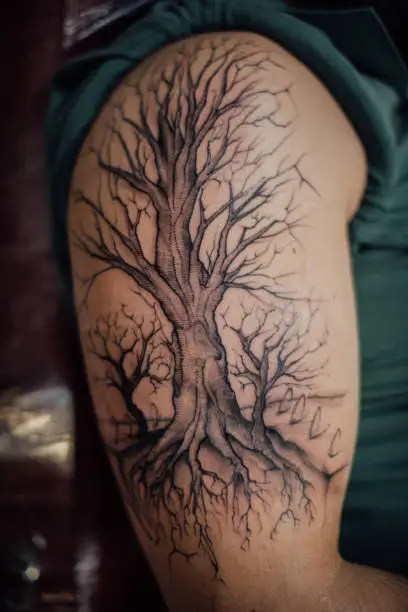
At its core, a poison tree tattoo is a piece of body art inspired by William Blake’s 1794 poem “A Poison Tree,” published in his collection Songs of Experience. The tattoo typically depicts a dark, gnarled, or leafless tree — sometimes bearing a glowing apple or fruit — and it symbolizes what happens to emotions when they’re left unspoken. Suppressed anger. Silent resentment. The kind of bitterness that doesn’t disappear when you swallow it — it grows roots.
It’s not a tattoo about death or destruction, even when it looks that way on the surface. More often than not, it’s a tattoo about honesty, survival, and the price of emotional silence. That duality is exactly what makes it so compelling.
William Blake’s “A Poison Tree” — The Literary Root of It All
To truly understand the poison tree tattoo meaning, you have to spend some time with Blake himself. William Blake was not a comfortable poet. He was provocative, spiritually restless, and deeply suspicious of social norms that demanded people mask what they truly felt. “A Poison Tree” sits within his Songs of Experience — a collection that serves as a direct counterpoint to his earlier, more innocent Songs of Innocence. Where innocence is naive and trusting, experience is wary, scarred, and knowing.
The poem opens with a simple contrast. The speaker is angry with a friend. He tells the friend. The anger ends. Then he becomes angry with an enemy — and this time, he says nothing. He nurses that anger quietly, watering it with his fears, feeding it with deceptive smiles and false warmth. The anger grows into a tree. The tree bears a bright apple. His enemy, drawn to the apple’s glow, sneaks into the garden and eats it. In the morning, the speaker finds his foe lying dead beneath the tree — and he is glad.
What Blake was describing wasn’t literal murder. He was mapping the anatomy of emotional repression. The suppressed wrath doesn’t disappear; it transforms. It becomes something external and dangerous, something that eventually destroys — not just the person it was aimed at, but the person carrying it. And here’s the detail most people overlook: the poem’s original title in Blake’s manuscript was “Christian Forbearance,” a bitterly ironic label for what is, at its core, a study in how virtue-signaling and emotional dishonesty poison the soul.
That original title matters. Blake wasn’t romanticizing the poison tree — he was warning against it. Which means the tattoo, at its most honest, is a cautionary mark. A reminder carved into skin.
The Core Symbolism — What Every Branch and Root Represents
The poison tree tattoo meaning isn’t singular. It branches — fittingly — into several distinct interpretations depending on who wears it and what they’ve lived through.
Suppressed Anger and Emotional Toxicity
This is the most direct reading. The tree represents anger that was never spoken. Every person who has smiled through something that broke them, or stayed silent when they should have spoken, understands this symbol on a visceral level. The tattoo doesn’t glorify that silence — it marks its consequences. People who choose this design often aren’t proud of the resentment they’ve carried. They’re acknowledging it. That’s a significantly different thing.
Betrayal and the Slow Rot of Trust
Many wearers connect the poison tree to specific betrayals — a friendship that turned toxic, a relationship that corroded from the inside, a family dynamic where honesty was never safe. The apple in these interpretations isn’t just a symbol of anger’s outcome; it’s the fruit of a poisoned relationship that looked appealing long after it had become dangerous.
Personal Transformation Through Darkness
Here the reading flips. The tree isn’t just a symbol of what went wrong — it’s evidence of what was survived. In this interpretation, the person wearing it has already walked through the darkness the tree represents. The tattoo marks a chapter that’s closed, not one that’s ongoing. It says: this happened, it grew, it bore its fruit, and I’m still here.
The Shadow Self
Carl Jung’s concept of the shadow — the hidden, unacknowledged aspects of the psyche that we refuse to integrate — maps almost perfectly onto Blake’s poem. The enemy in the poem who eats the poisoned apple can be read as the shadow self: the thing we send into the garden of our own making because we refused to face it in daylight. People drawn to Jungian psychology, shadow work, or therapy often find the poison tree an unusually honest symbol for that internal process of confrontation and integration.
| Symbolic Element | Common Interpretation |
|---|---|
| Gnarled / leafless tree | Emotional emptiness, long-held grief, or hardship endured |
| Bright apple or fruit | The dangerous outcome of nurtured resentment; temptation |
| Deep roots | Buried trauma, unresolved conflict feeding the whole |
| Spreading branches | The way toxicity reaches outward into relationships |
| Thorns | Pain as protection; the cost of being guarded |
| Birds or crows | Omens, the unconscious, freedom beyond the darkness |
| Skull at the base | Death of a former self; consequences fully reckoned with |
| Gothic moon | Secrecy, hidden emotion, the night of the poem’s ending |
XXXTentacion and the Poison Tree — Why This Tattoo Went Viral
No discussion of the poison tree tattoo meaning in the 21st century is complete without acknowledging XXXTentacion — the artist born Jahseh Onfroy whose influence on this symbol has been profound and lasting. X carried a tree tattoo that his fans directly connected to Blake’s poem, and his 2017 album 17 — drenched in themes of emotional isolation, unspoken pain, and the cost of suppressed darkness — felt like a musical companion to everything Blake put into four stanzas in 1794.
The Reddit thread among his fanbase that connects the poison tree symbolism to his personal life and artistry reads like literary analysis from people who never planned to write literary analysis. They trace the connections between Blake’s narrator and X’s own emotional honesty — or lack of it — in his music. That kind of organic, deeply personal engagement with the symbol is part of why this tattoo has remained culturally alive far beyond the usual lifespan of a trend.
For many fans, getting a poison tree tattoo is a tribute. For others, it’s a way of saying that they understand what X was drawing on — that they’ve lived inside the same emotional architecture. The tattoo becomes a conversation between grief, admiration, and self-recognition.
Cultural and Mythological Layers Across the World
What makes the poison tree a genuinely powerful cross-cultural symbol is that versions of it appear in traditions Blake couldn’t have directly drawn from — yet they all arrive at similar truths.
In Buddhist philosophy, anger is considered a poison that affects the person who harbors it far more than the person it’s directed at. The tree, in this context, becomes a warning about spiritual self-harm — how resentment contaminates the inner landscape of the person cultivating it. In Celtic tradition, trees were sacred intermediaries between the physical world and the divine. A corrupted or poisoned tree represented the corruption of natural order — goodness turned against itself by hidden forces. Norse mythology offers Yggdrasil, the world tree, whose roots extend into realms of danger and death. Even the tree at the center of existence has darkness woven into its foundation. And in the Garden of Eden — the most recognizable tree-and-apple narrative in Western culture — the forbidden fruit represents knowledge and consequence, beauty concealing danger.
The poison tree tattoo sits at the intersection of all of these readings. Depending on your background and the design you choose, it can draw on any of them — which is part of why so many people across so many cultures find something personally true in it.
Poison Tree Tattoo Meaning for Men and Women
While tattoos aren’t inherently gendered, the reasons people choose this particular design do sometimes split along emotional lines that are worth understanding.
For men, the poison tree often represents a reckoning with emotional suppression that was culturally enforced — the years of being told that anger was acceptable but vulnerability wasn’t, that silence was strength. Wearing this tattoo is frequently an act of counter-narrative. It says: I know what silence does. I’ve seen the fruit it bears. That’s not strength I want anymore.
For women, the reading tends to be different but equally powerful. The poison tree is often chosen as a reclamation of anger — an acknowledgment that women’s anger is so frequently dismissed, redirected, or labeled as something else that it does exactly what Blake described: it goes underground and grows in the dark. The tattoo marks the decision to stop swallowing it.
In both cases, the design functions as a kind of emotional autobiography. It’s not decoration. It’s declaration.
Design Styles and What Each One Communicates
The style you choose for a poison tree tattoo does as much symbolic work as the image itself. A fine-line minimalist tree reads very differently than a blackwork piece with gothic elements — and both are valid, but they’re saying different things about the wearer’s relationship to the symbol.
Blackwork remains the most popular approach, and for good reason. The high contrast between solid black ink and bare skin amplifies the drama inherent in the subject. There’s no softening here, no compromise. Blackwork poison trees tend to have gnarled, skeletal branches, heavy root systems, and occasionally an apple rendered in dense negative space. They suit people who aren’t interested in softening what the tattoo means.
Fine-line and minimalist designs approach the same subject with restraint. A single-line poison tree, sometimes no larger than a hand, carries the symbolism without announcing it. This style suits people who value the personal nature of the meaning over the public statement — the tattoo is for them, not for observers.
Neo-traditional designs bring bold outlines and controlled color into the picture. You might see a poison tree with deep green and black tones, an apple rendered in blood red, or stylized foliage that tips into illustrative territory. This style tends to attract people who want the emotional weight of the symbol but also want the tattoo to function as arresting visual art.
Gothic and surrealist interpretations lean fully into the eerie atmosphere of the poem — skulls nestled in roots, crows perched in branches, a full moon partially obscured by leaves. These designs wear their darkness openly and suit wearers who connect to the aesthetic as much as the symbolism.
Adding Blake’s text to the design — a line or two from the poem, typically in fine-line script beneath or beside the tree — creates an explicitly literary piece. “I was angry with my foe: / I told it not, my wrath did grow” is among the most chosen, and it anchors the design immediately in its source.
| Tattoo Style | Best For | Typical Elements |
|---|---|---|
| Blackwork | Bold emotional statement | Heavy branches, dense roots, negative space apple |
| Fine-line / Minimalist | Personal, subtle symbolism | Single-line tree, small format, wrist or inner arm |
| Neo-traditional | Art-forward with symbolic depth | Bold outlines, controlled color, stylized foliage |
| Gothic / Surrealist | Full atmospheric commitment | Skulls, crows, moons, thorns, dramatic shadow |
| Illustrative / Literary | Blake devotees and readers | Poem text integrated, storybook linework |
| Watercolor | Soft emotional transformation | Bleeding color washes, less defined silhouette |
Placement and What It Says About You
Where you put a poison tree tattoo isn’t just an aesthetic decision — it’s a symbolic one. Visible placements communicate something fundamentally different from hidden ones, and tattoo artists who specialize in meaningful pieces will often ask about placement before they ask about design.
A forearm piece is an act of openness. You’re not concealing what you’ve carried. That visibility signals that the emotional chapter the tattoo represents has been processed enough to wear publicly — that you’re no longer ashamed of the anger, the grief, or the journey. The back, by contrast, carries the weight quietly. You bear it, but you don’t necessarily offer it for public viewing. Chest and rib placements tend to be the most intimate — closest to the heart, hidden under clothing, known only to those you choose to show.
Behind the ear or on the neck is a bold placement for a bold statement. People who choose this location tend to be fully reconciled with the tattoo’s meaning — they’re not concealing anything from anyone.
How to Get a Poison Tree Tattoo — Practical Guidance
Once you’ve decided the symbolism resonates, the practical questions begin. Finding the right artist matters enormously with a design like this. Look for someone who has demonstrable experience with botanical tattoos, blackwork, or literary-inspired pieces — not just technically, but in terms of understanding what clients want a meaningful tattoo to do. The best artists in this space will spend as much time in your first consultation asking about the personal significance as they will discussing design.
Budget realistically. A small, fine-line poison tree on the wrist might run between $150 and $350 depending on the artist and location. A detailed blackwork piece covering a forearm or half-sleeve could range from $600 to $1,500 or more. Quality tattoos in this genre require experienced hands, and experienced hands charge accordingly. This isn’t the design to shop for on price.
Plan for the healing process. Initial healing takes two to three weeks, during which you’ll need to keep the tattoo clean, moisturized, and out of direct sunlight. Full skin healing — the point at which the tattoo settles into its final appearance — takes two to three months. The aftercare you invest in during this period directly affects how the design ages.
Conclusion — The Tree That Grows in the Dark
The poison tree tattoo meaning has endured because it names something true about human experience that most people never find the right words for. We all know what it feels like to nurse a wound in silence, to smile through something that cuts, to watch resentment grow in the places we refused to look. Blake understood this. XXXTentacion felt it. And the people who choose this tattoo are, in their own way, choosing honesty over concealment — committing the thing they’ve carried to something permanent, not as a celebration of darkness, but as a refusal to pretend it wasn’t there.
Wear it knowing what it says. That’s the only way to wear it well.
Frequently Asked Questions
What does the poison tree tattoo symbolize?
The poison tree tattoo symbolizes the consequences of suppressed anger and unspoken emotion. Rooted in William Blake’s 1794 poem of the same name, it represents what happens when resentment is nurtured in silence rather than expressed honestly — it grows, festers, and eventually bears dangerous fruit. For most wearers, it also carries a second layer of meaning: personal transformation, the acknowledgment of darkness as part of a full human experience, or the decision to stop carrying what has gone unprocessed for too long.
Is the poison tree tattoo connected to XXXTentacion?
Yes, significantly. The artist Jahseh Onfroy (XXXTentacion) wore a tree tattoo that fans widely associated with Blake’s poem, and his 2017 album 17 explored themes of emotional isolation and suppressed pain that closely mirrored the poem’s central concerns. Many fans choose this tattoo as both a tribute to X and a personal identification with the emotional territory he articulated in his music.
Where is the best placement for a poison tree tattoo?
Placement depends on how publicly you want to carry the symbol. Forearm placements signal openness and comfort with visibility; back placements carry the meaning more quietly. Chest and rib placements tend to be the most intimate. There’s no universally “best” spot — the right placement is the one that aligns with your personal relationship to what the tattoo means. Ask yourself whether you want this to be seen or felt.
Is the poison tree tattoo negative in meaning?
Not necessarily. While the imagery is dark and the poem is a cautionary tale, most people who choose this tattoo do so as an act of self-awareness rather than self-destruction. The tattoo acknowledges darkness without being consumed by it. Many wearers describe it as a marker of transformation — something that represents a chapter they’ve moved through rather than one they’re still living in. The meaning you bring to it shapes what it becomes.
What style works best for a poison tree tattoo?
Blackwork is the most popular style for this design because the high contrast amplifies the emotional weight of the subject. Fine-line minimalist designs suit those who want the symbolism without the visual boldness. Gothic and surrealist styles lean fully into the atmosphere of Blake’s poem. The best style is the one that fits both your aesthetic preferences and your personal relationship to the symbol — discuss both with your artist before committing to a direction.
For more quality, informative content, visit writewhiz